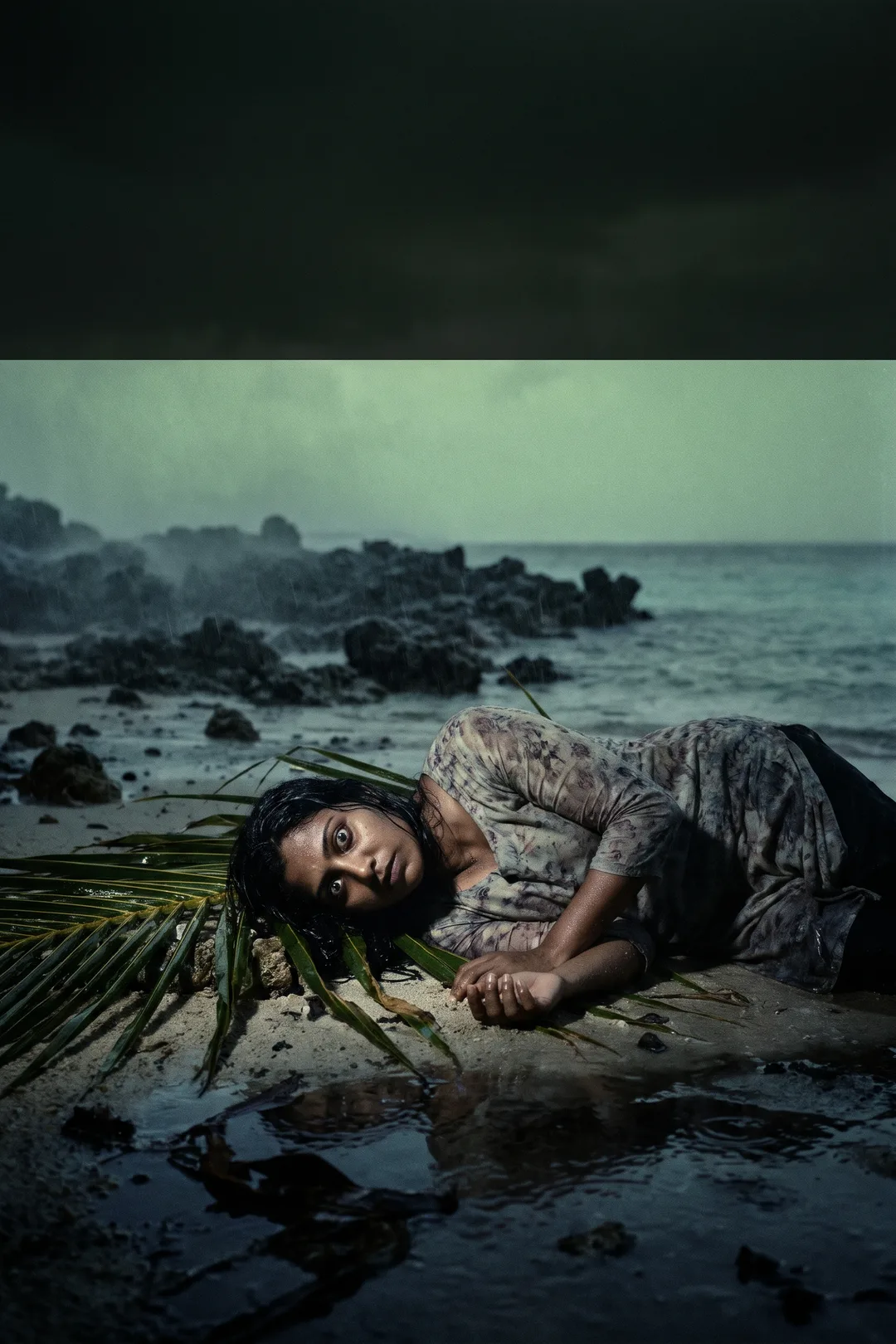
Lady Midday Wants One Hour
A tall woman in white stood at the far end of the flax plot, where the heat came up off the ground and made the air shake. A sickle hung from her right hand with the blade turned down against her skirt. Nobody used a sickle on flax. You pulled flax up by the roots so the fibre stayed long; Grandmother had said so a hundred times.
Hanka was on the dike with the lunch basket on her arm: potatoes, a dish of quark with linseed oil poured over it, bread under a cloth, and a jug of buttermilk that knocked her hip at every step. From the top of the dike she could look straight down their strip: the ditch along the foot of the dike with a plank across it, the one willow on the ditch bank at the corner, and the flax running away from it to the far end. Grandmother had been buried the day before Hanka first saw the woman, and Hanka had known at once what she was. That noon she had stood by the alders two plots away, and the next noon at the edge of the neighbours' flax. Today she was at the end of theirs.
Father was bent in the rows, pulling handfuls and laying them flat behind him to dry. He straightened when Hanka called, came up to the ditch and wiped his face on his sleeve.
"There," she said, and pointed.
He looked for a while. "That's the heat off the water. Stop staring at it, you'll give yourself a headache." He drank half the jug standing up. "Put the rest in the shade."
"Come home and eat. Everyone goes home when the bell rings."
He turned on her with his hands full of roots and earth. "I buried my mother days ago, Hanka. I'm not losing the flax as well." He was already bending again.
All spring, at the wheel by the window, Grandmother had made her say it. Sowing, pulling, rippling, retting, breaking, scutching, heckling, spinning, weaving, bleaching. Then again, slower, with everything inside each step. Once, around Easter, Hanka threw down the distaff and asked why she had to keep saying what she already knew.
Grandmother kept the wheel turning and told her about her own mother, who had met the Přezpołdnica, Lady Midday, in the rye when she was a young wife. The woman in white asked her about the weather, and she talked weather for nearly the whole hour, rain and hail and what the clouds over the forest meant. Then, near the end, she let it slide into her husband's back and how the damp got into it. The sickle came down. "It stopped at her neck," Grandmother said, "only because the bell went for one just then. And where the woman had stood, the rye Mother had cut that morning was standing up out of the stubble again. She was never right after. She used to sit and smile at the wall."
She stopped the wheel for the next part. "My mother said it was the one thing everybody knew and nobody thought would be them. You keep to one thing with her, whatever it is, from the first word till the church rings one, or she takes your head. Mother had the weather, because that's what she was asked, and weather runs out. She said afterwards she should have talked about something she'd done with her own hands all her life." Then she started the wheel again. "Sowing."
That evening Hanka tried to tell Mother about the woman in white. Mother was scrubbing the pots from the funeral meal and said that grief made people see things in the noon heat, and to go to bed. So Hanka asked Father if she could bring his food an hour early, so he could eat and she could be off the dike before the bell. He said fine.
The next day was the hottest of the summer, and the kitchen fire had gone out in the night. The wood by the channel was damp, and Mother blew at the hearth until she coughed. Hanka waited for the potatoes as long as she could stand it, then took the bread and the buttermilk and ran.
The noon bell rang across the water while she was still on the dike. The last neighbours came the other way with their rakes over their shoulders, and one of them waved and said something about the heat. Then the dike was empty.
Father stood up from his row as she crossed the plank, and came toward her slowly. When he took the jug his hand shook. He had not drunk since dawn, he said, because she was late. He drank, then sat down on the laid flax to drink the rest, and said his head was splitting. A little later he said he couldn't see properly. He tried to get up, and his knees went, and he fell over sideways among the stalks. Hanka got him under the arms and pulled toward the willow on the ditch bank, a dozen steps back the way she had come. He was too heavy, and her heels slid in the dry earth. She got his head and shoulders into the edge of the willow's shade with his legs still out in the sun. Then she ran back across the plank and up the dike after the neighbours, shouting, but they had already gone round the bend behind the alders, and nobody heard her. She could not leave him lying there to run after them. She came back down, pulled off her headcloth, dipped it in the ditch and laid it wet across his forehead and eyes, and opened his shirt at the neck.
A shadow fell across them both.
The woman was standing over them. Close up her face was young and very white, with pale eyes, and her feet rested on the pulled stalks without pressing them down. The sickle hung by Father's head. The bell had been silent for some while now, and it would not ring again until one.
"What is this field for?" she asked. She spoke Sorbian, the village's own tongue.
Hanka looked down the empty dike. The village was a quarter of an hour away at a run, and a quarter of an hour back with whoever she could find. All that time Father would lie here with the blade beside his neck and nobody talking to her. Hanka knelt in the dirt beside him.
"Flax," she said. "It's for flax. You sow it in spring, when the birch leaves are as big as a mouse's ear. Father always says the seed—"
The woman's pale eyes went to Father's face, and the sickle turned in her hand until the edge lay toward his neck. Hanka had gone from flax to Father.
"The seed goes in thin," Hanka said, fast, "as thin as you can make it, so the stalks grow tall and don't branch, because a branched stalk gives you short fibre." The woman's eyes came back to her, and the blade stayed where it was. Father breathed through his open mouth under the wet cloth.
"Then you pull it," she said. "You don't cut it. You take a handful low down and pull it straight up out of the ground, and knock the earth off the roots against your boot, and lay it flat behind you with the heads all one way so it dries even." She went on to rippling the seed heads off through an iron comb, and retting the bundles weighted down in the pond for nine or ten days until they stank and the fibre slipped free of the wood. Sweat ran into her eyes and she let it. Her mouth went dry. The edge of the willow's shadow crept off Father's shoulder, and she dragged him after it by his shirt, still talking about the pond. Past the woman's skirt she could see the church tower across the water, and it told her nothing. She talked breaking and scutching, and when she stopped to swallow in the middle of heckling and lost her place, she said "the fine comb, then the fine comb" before she knew she was speaking. Spinning. Weaving. Bleaching the cloth on the grass, wetting it every morning for weeks until the grey went out of it.
Then there were no more steps, and no bell. The shadow had not moved far enough for one o'clock.
The sickle began to rise. Hanka opened her mouth and nothing came. The blade came level with Father's ear. Linen was flax too; Grandmother had made her say the cloth as well. All she could think of was Grandmother's hands on it, so she held on to that.
"The best linen goes in the chest," she said. "Grandmother's went in the chest under the window. She wove it years ago, before her hands went bad, and it was the last cloth she ever wove. Twelve ells, and nobody was allowed to use it. This spring I helped her hem the end of it. She made me do the stitches again because they were crooked. When she died, Mother and the neighbour women washed her and wound her in it. It went round her twice. It was so white in the coffin you could hardly look at it. They put the lid on while everyone was singing, and the last thing I saw was the linen."
She kept her eyes on the woman's face and every sentence on the cloth, the thread and the weave, the stitches she had pulled out and done over. The sickle hung where it was and did not come down. She was telling how the hem lay at Grandmother's feet when the one o'clock bell rang across the water.
The woman was gone. The stalks she had stood on, flax Father had pulled and laid flat that morning, were standing upright on their roots, the way Grandmother had said the rye stood up. Hanka reached out and touched one. It was dry, with loose earth still on the roots, and it stood there anyway.
Father pulled the cloth off his eyes and looked at her, at her wet face and the dirt on her knees, and asked for water. When she told him, he said she had been dreaming in the heat. She pointed at the upright flax. He looked at it for a long time, and then he stopped arguing. After that he came home with the others when the noon bell rang.
On Sunday the pastor gave out the hymn they had sung at the funeral. Hanka stood with the book open. The last time she had gone through the funeral, she had been saying it to the woman in the field, and she could not get her mouth to move. Mother nudged her once, then looked at her face, held the book lower so they could both see it, and sang for the two of them.
Should this become an Enigma video?
0 votes
Comments
Be kind. An editor checks every comment before it appears.
No comments yet. Be the first.