He Took Her Place for the Rannamaari
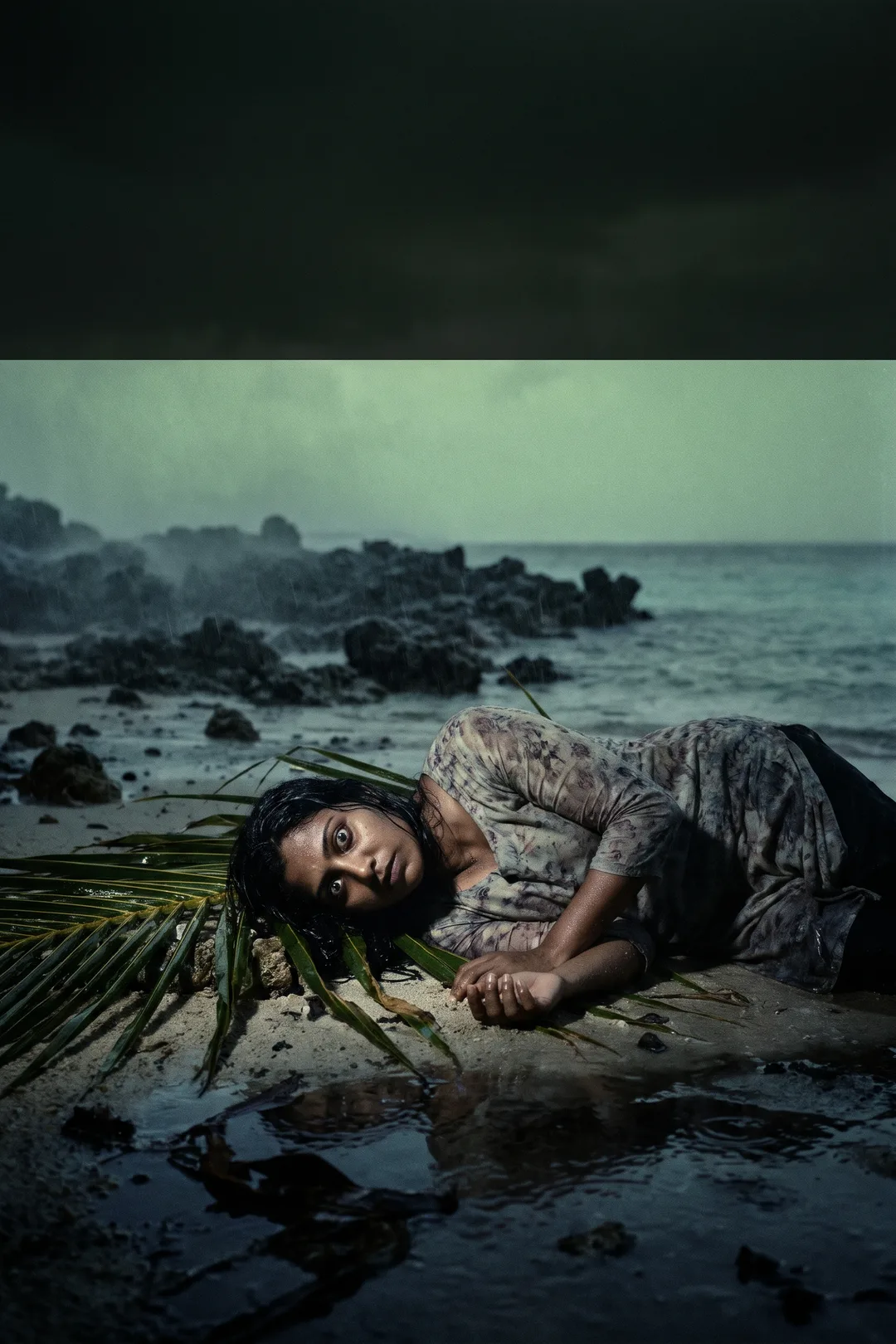
Every girl on Malé knew the dry sound the palm-leaf strips made in the basket. At the start of every month the families stood in the king's yard in the heat, mothers in front and daughters behind, and listened to the official stir them with his hand. This month he took one out and read the name scratched on it twice, because the first time his voice went. It was hers. She was fifteen, the only child of a widow who twisted coir rope for the boats, and she felt the woman beside her step away.
Mama made no sound at all. Then she pushed through to the front, past the other mothers, and took hold of the official's arm with her rope-scarred hands and begged him to draw again. He said it had been drawn. She said draw again, it was a mistake, the leaf had stuck. Two of the king's men walked her back to the crowd, not roughly, and one of them said he was sorry.
The traveller was standing in the doorway of the back room when they came home. He had lodged with them three weeks, a young man from the Maghrib, far to the west, slight and beardless and hardly taller than she was, and he paid in rice. He shared no word with them. Every morning before light he knelt and recited something in his own language, loud enough that the woman next door had come round twice to complain.
Mama pointed at the sea. "Rannamaari," she said. He shook his head. He didn't know it.
Every child on Malé knew it. In the last week of every month the lamps showed on the horizon and came a little closer each night. On the last night of every month the Rannamaari, the demon of the sea, came in through the channel to the temple on the eastern seafront, and the girl barred inside that temple alone was dead by dawn. Since she was small she had walked to the temple door at dawn with the other families, and seen what they carried to the burning ground in the shroud-cloth.
Seven nights before the month's end she climbed onto the coral-stone wall at the back of the compound, where the lane ran out onto the beach, and saw the lamps, a faint smudge she could hide with her thumb. The next night the smudge had come apart into separate lights, and she counted nine. On the fourth night their glow lay on the water under them, and on the fifth it lit the white of the breakers on the reef. In the cook-hut Mama sat by the coconut-husk fire with a length of shroud-cloth and a needle, as every mother whose daughter was drawn sat, and didn't go to bed.
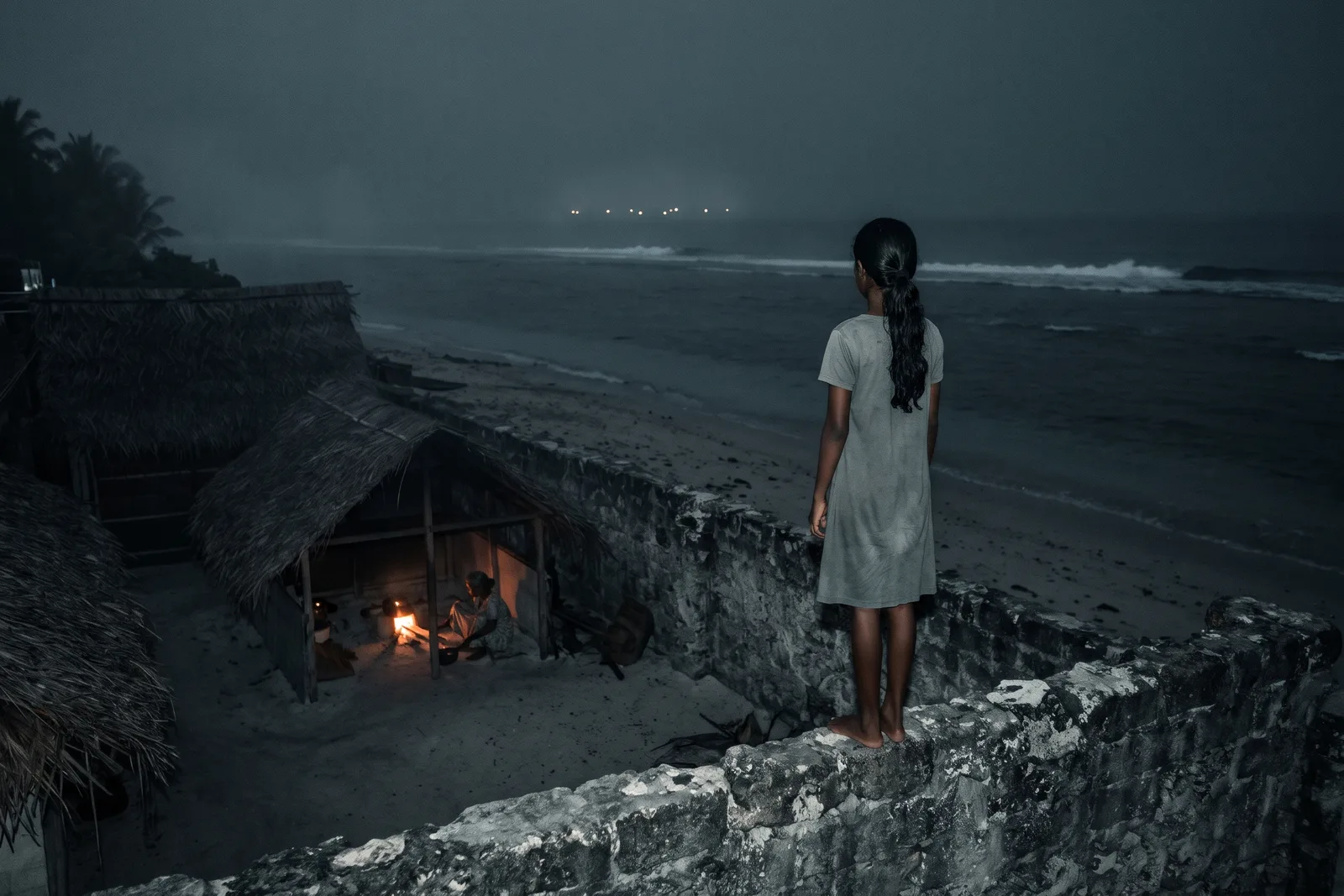
That fifth night she went down to the beach with a bundle of dried fish and untied a fisherman's canoe. She had the rope in her hands when Mama caught her by the wrist.
"If you go, they draw again," Mama said. She was breathing hard from running. "It could be the girl next door."
The girl next door had plaited her hair on their step since they were both small. She let go of the rope, and Mama walked her home without letting go of her wrist.
On the sixth night the traveller came and sat by the fire while Mama hemmed the cloth. He touched it and raised his eyebrows. Mama put down the needle. She pointed at her daughter, then east toward the temple, then out at the sea, and made a ship with her hand. Then she lifted the cloth and laid it over her own face, and under it her shoulders began to shake. He looked at the girl, then at the cloth, and his face went grey.
He went very still. After a while he pointed at himself. He pointed at the wrap hanging on the line outside, then east again.
Mama shook her head and turned her back on him, and would not look at him. He was a guest under her roof, and a guest was not something you sent to the temple.
He knelt on the floor and raised his hands beside his face and began, low, the words he said every morning. Then he put his hand flat on his chest and pointed east. Mama said no, out loud this time, and went out onto the sand of the compound.
Mama stood there a long time, facing the neighbour's door. From the doorway her daughter understood it then: if the stranger went, no one's daughter went this month, and not the neighbour's either. On the last evening Mama came in and nodded once, at the floor, not at either of them.
Mama took the wrap off the line herself. She had washed it that morning, as mothers did for the last day, and it was still damp at the hem. She held it out to him, and he took it carefully.
By custom the drawn girl went under a white head-cloth that fell to her feet, she said nothing, and the temple keepers never looked at her face. At dusk the keepers came to the door, and every other door on the lane was shut, as on every last night. He stood in her wrap under the head-cloth, his lips moving behind it, and they took him by the arm with their eyes turned away and walked him east. She listened to their feet on the sand until there was nothing.
Then she climbed onto the wall.
The lamps were already inside the reef. They came slowly through the channel, nine of them, low on the water. One dipped behind a swell and there were eight, and her stomach dropped before it rose again. Nine.
Mama sat on the cook-hut step below with the folded shroud-cloth in her lap. "How many?" she said.
"Nine."
The lamps moved along the eastern shore and stopped off the temple, below the window on its seaward side. Their light lay on the water and on the pale coral of the temple wall. A smell came over the island like kelp left a week on the beach, thick enough that she breathed through her mouth, and the dog two houses down, which barked at everything, crawled under the neighbour's step and stayed there.
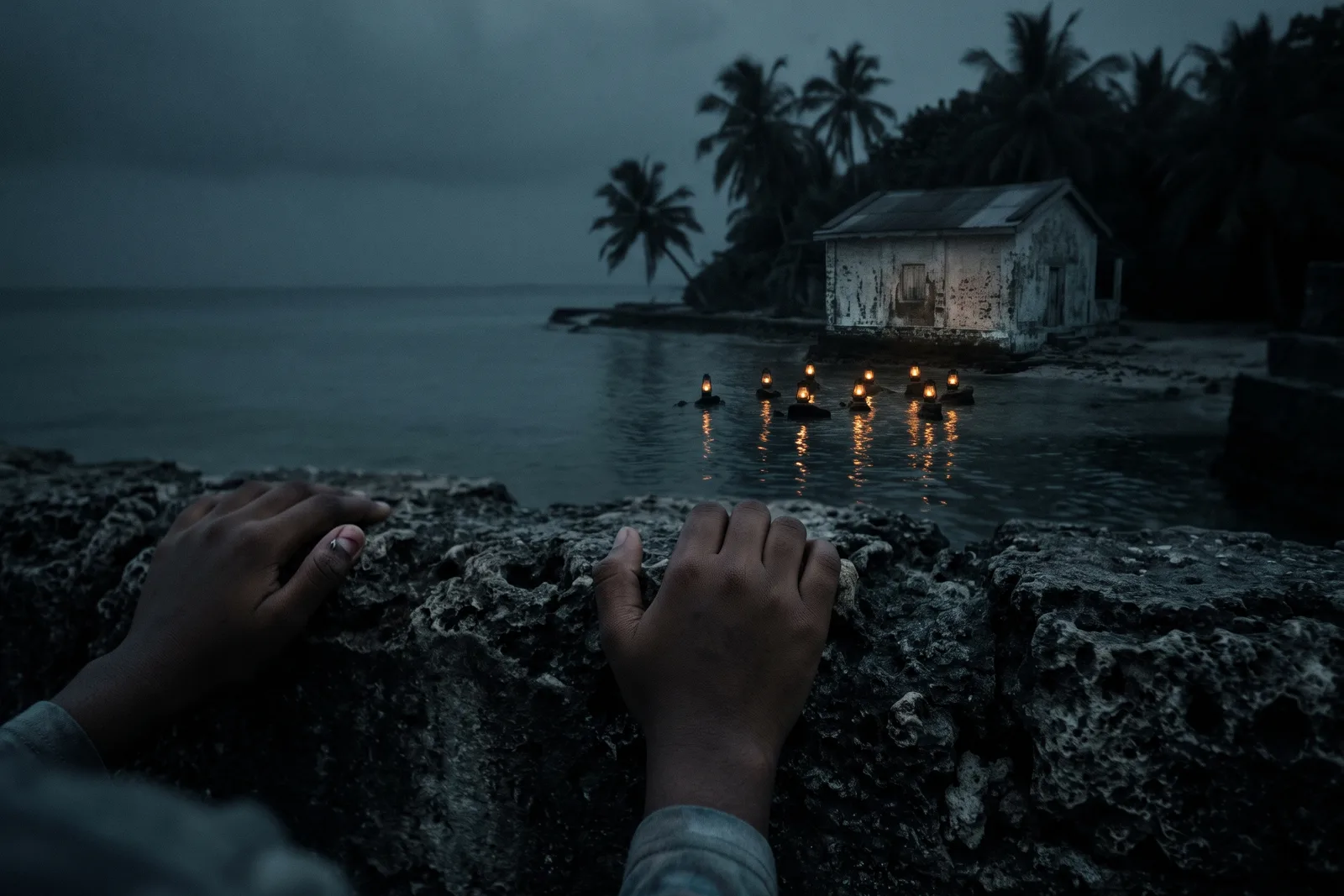
She leaned toward the temple until her arms shook. The surf went on against the reef as it always did, and under it, so faint that at first she thought she was making it up, a voice was going, rising and falling, the sound that came through the wall every morning. She pressed her fingers into the coral until a nail split. For a moment she was glad it wasn't her in there, and then she felt sick.
"I could go and knock," she said down to the step.
"Then it has two," Mama said. "Sit."
She got one leg over the wall, toward the lane, before she sat again.
Much later the lamps rose. They came up off the water all together, like lanterns lifting when the people holding them stand, and drifted onto the shore and up to the temple until their light was in the window and the coral round it shone a sick yellow-green. Under the step the dog began to whine, a thin sound that went on and on.
Mama stood up. "How many?"
"Nine. They're at the window."
The voice inside didn't stop. It got louder, hoarse and cracking, and now she could hear it over the surf, the same words over and over. The light stayed in the window. Her legs went numb and she didn't change how she sat. She lost track of how long it went on, only that the voice kept going and the light didn't move.
Then the lamps fell back. They went down the shore all at once, faster than they had come, and dropped into the sea in front of the temple, and the sea jumped. A wave came off that spot with no wind behind it. It broke white over the temple step and ran along the beach both ways, and she heard it come hissing up the sand at the end of the lane below her and pull back.
The water was black. There was nothing on it.
"How many?" Mama said.
"None."
Mama sat down on the step again. The voice from the temple was still going, thinner now. The smell stayed until the sky went grey, and then it thinned on the wind, and there was no ship in the channel and none past the reef.
At dawn the families walked to the temple, as they had every month, Mama in front with the shroud-cloth folded over her arms. Her daughter walked behind her. The neighbours stared at her the whole way. Only the girl next door spoke, in a whisper, "Then who's in there?" and her mother hushed her, because nobody on the lane spoke of the drawn girl before the bar came off.
Before the keepers lifted the bar, everyone heard it from inside. A man's voice, hoarse, nearly gone, still reciting.
The woman next door muttered it to nobody, her eyes on the bar. "That's what comes through my wall every morning."
The keepers lifted the bar. He came out with the head-cloth bunched in his fist and her wrap soaked and crusted white with salt at the hem, where the wave had come in under the door. Salt had dried in a white line across his face too, and his eyes kept going to the water. His hands were shaking. He pulled the wrap off over his head and put it into her hands and walked down to the water and knelt there.
She ran home for the gourd and brought it to him full. He drank all of it without looking up and gave it back, and she stood beside him holding it empty while he began again, very quietly, the words he said every morning. Mama carried the shroud-cloth home folded, unused.
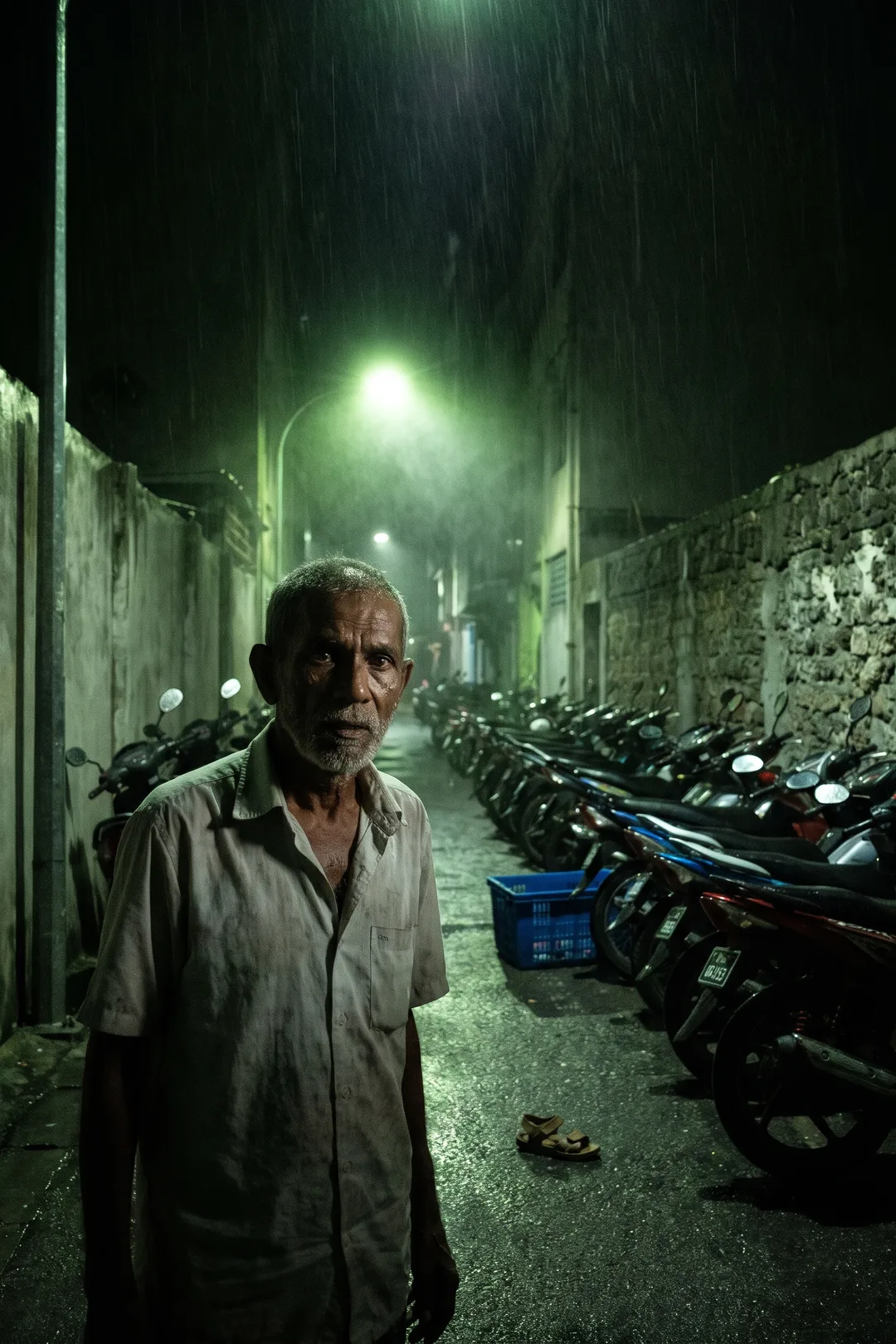
In the lane they still say the Rannamaari could not stay where those words were said. They say the king sent for the stranger that same day and asked him to sit in the temple one more last night, and that afterwards the king had the temple pulled down and took up the stranger's faith, and all Malé after him, and that the words were the Quran and the stranger's name was Abu al-Barakat. Mama washed the wrap twice and folded it into the bottom of the box.
On the last night of the next month the king's men walked him east again, in his own clothes this time, because the king wanted to be sure, and she was back on the wall. There had been no smudge on the horizon all week. The sea past the reef was dark all the way out. She looked at the place where the lamps had first shown, and the reef, and the channel, and there was nothing to count. Mama called up to ask what she was doing, and she said nothing, and stayed until the sky went grey, unable to take her eyes off the empty sea, still watching for the first lamp.
Should this become an Enigma video?
0 votes
Comments
Be kind. An editor checks every comment before it appears.
No comments yet. Be the first.