The Fureytha of Kinolhas
Content note: Deaths in a family, including a child.
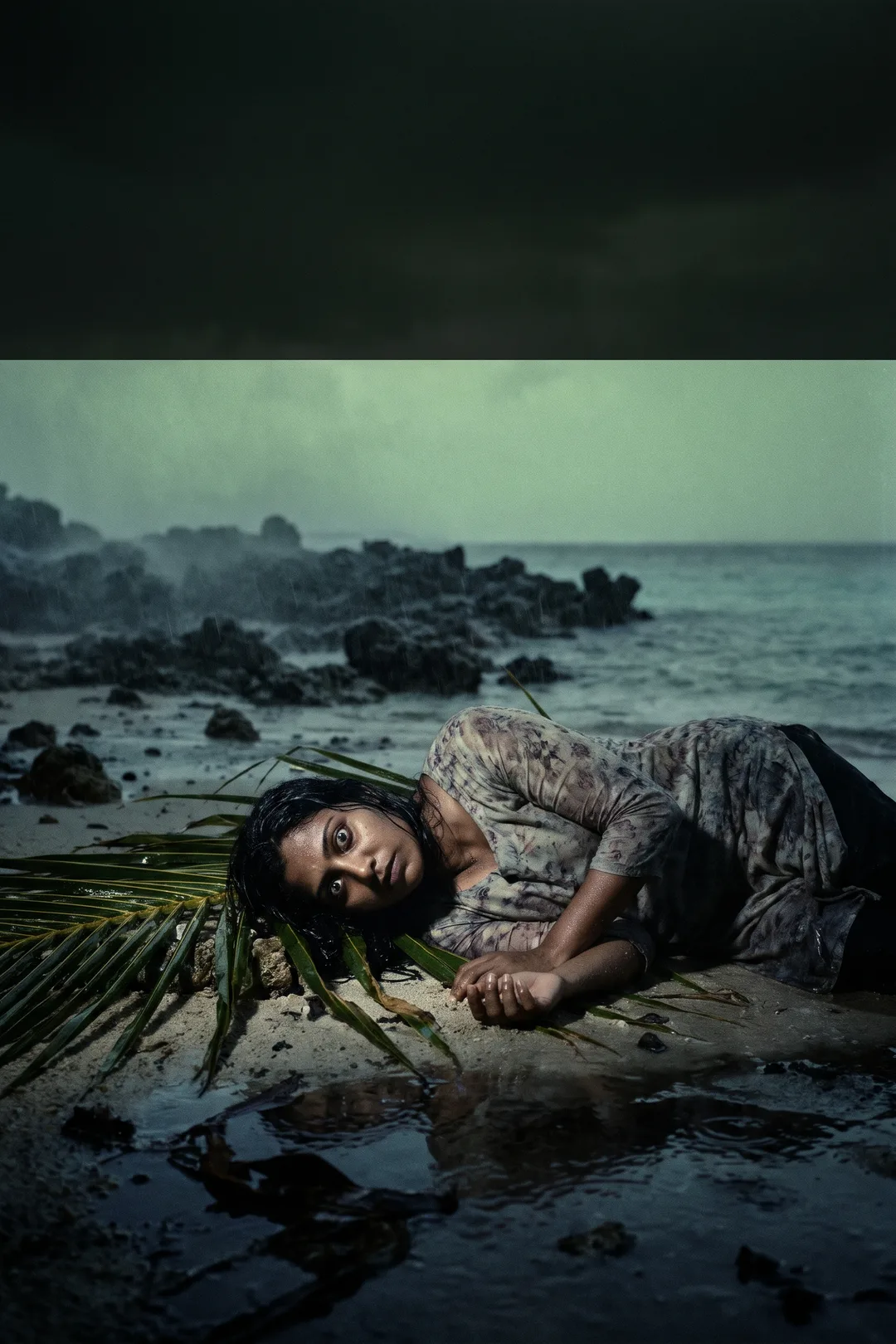
The storm sat over Raa Atoll for most of a week, long ago, and when the wind dropped, the beach on Kinolhas was green with torn palm fronds. The fishermen went down at first light to see what was left of the dhonis, and found a woman lying above the tide line.
She was on her side, with her knees drawn up. She looked about thirty, and her eyes were open. Nobody on Kinolhas knew her face, and there was no wreck on the reef, no plank or broken mast anywhere on the beach. One of the older men crouched and touched the edge of her libaas, then her hair. "This is dry," he said. "It rained all night. How is this dry?" Nobody answered him. They asked her name, and where her boat was, and she said nothing, but she let them lift her. Hussain, the youngest of them, had her feet, and his mother Mariyam's house was nearest, so they carried her there. His little sister, who was seven, ran ahead to hold the gate open.
Mariyam had been a widow for three years and had never turned anyone from her door. She gave the woman rice and fish and a mat in the back room, where Hussain's grandmother slept behind a cloth curtain, because there was no other room to give her. The woman ate slowly and did not thank her. The Katheeb, who was head of the island, came before noon, got no further with his questions than the fishermen, and said she could stay until a boat could take her home.
Hussain's grandmother fell sick four days later. She lay behind her curtain and would not eat, and would not let them move her from the corner she had always slept in, with the stranger asleep on her mat a few feet away, and on the third night she died. The stranger did not come to the grave.
Then his sister took sick. She had spent every afternoon beside the stranger, chattering at her and lining up cowries on the mat between them, though she never got an answer. She woke hot one morning and could not lift her head. Mariyam carried her through to the front room, and the cowries stayed in their line on the mat where she had left them. For five days she got no better. Mariyam sat with her by day and Hussain took the nights, fanning her with a folded mat, wetting a cloth from the water jar for her forehead, sleeping in snatches against the wall. On the fifth night, near dawn, she opened her eyes and asked for water. He held the cup while she drank a little. Then she asked for the lady.
Hussain did not answer her. He put the cup down, and when he looked up the stranger was standing in the doorway to the back room. He had not heard her get up or cross the floor. She looked at the child with her hands at her sides, the way she looked at the rice Mariyam put in front of her, and Hussain stayed where he was on the floor with the fan in his hand. When he turned back to his sister, she had stopped breathing.
The woman next door had sat with the stranger most afternoons, when the stranger took her mat out into the yard, in the shade of the wall the two yards shared. A week after the child was buried she took to her mat, and four days later she was dead. Her husband had nursed her himself, and he died ten days after her. By then mothers on the lane were calling their children in before dark and keeping them off the wall. People said the well had gone bad in the storm, or that a fever had come down from the north. The stranger was not sick for one hour. She ate, she slept, she sat.
The day the neighbour was buried, Mariyam went to the Katheeb's house without stopping for her slippers. She told him that everyone who had died had slept near the woman or sat with her. She herself had only ever put food in front of her and gone back to her work, and she did not know if that was what had kept her well. That night the Katheeb had the stranger moved to an empty house at the end of the lane, with food left at the door and nobody to go in, and at first light he sent a dhoni to Malé to find a good fanditha man. Mariyam told Hussain to go with it. "I don't want you here," she said.
In Malé they were sent to an older man called Odithaan Kaleyge. He heard them out in his doorway, asked how many had died and in which houses, and went inside for his things. On the way back he asked only whether the woman had been wet when they found her. Hussain told him about the dry hair, and Odithaan looked at the water for the rest of the way.
They were gone four days, and landed back late in the afternoon. Before he went near the empty house, Odithaan had Hussain take him through Mariyam's house to the back room, where the cowries still lay in their line on the stranger's mat. He looked at them a while and did not touch them.
At the empty house he stood in the doorway a long time. The woman sat against the wall with her hands in her lap and looked back at him. Then he went in and sat down on the floor across from her, close enough to touch, which nobody on Kinolhas had done since she was moved. He asked her name, and she said nothing. He asked where she had come from, and why there had been no boat, and why her clothes had been dry, and she said nothing to any of it. Hussain waited in the lane with the Katheeb. They could see her face over Odithaan's shoulder, and it did not change. After a while Odithaan got up, slowly, with a hand on his knee, and came out and stood beside the Katheeb. "This is no ordinary woman," he said. "She is a fureytha."
He went out into the lane and began to recite. Inside, the woman got to her feet, as if she meant to go out the back, and stopped with one hand half raised. Her eyes moved and nothing else did. Two of the fishermen carried her out between them, stiff as a post, and set her on the sand in front of him. By then the whole lane had come. Mariyam came through to the front and stood with her arms wrapped round herself.
Odithaan kept reciting. Between verses he asked the woman how she had come to Kinolhas.
It was the first time anyone had heard her voice, and it was an ordinary woman's voice, low and unhurried. "I saw the island without any fanditha protecting it," she said. After a moment she added, "I wished to remain on Kinolhas."
Nobody spoke. People looked at each other and then at the ground, and the Katheeb kept his eyes on the sand in front of him. Mariyam did not look at him. She had her eyes on the woman and kept them there.
Odithaan began another verse. The woman's shoulders drew in and her libaas hung loose on her, and by the end of the verse a girl of seven or so stood in the heap of cloth, with the woman's face made small and the same unhurried eyes. Mariyam made a sound and looked away. He did not stop. At the next verse the girl sank down into the cloth until there was nothing standing. He lifted the edge of it. Something crouched on the sand no bigger than his palm, with arms and legs and a head, and dark hair down its back, dry. It turned its face up to him and watched his mouth while he recited, and the people nearest stepped back. He covered it again and finished the verse. When he lifted the cloth a second time there was only a small pale worm, no longer than a fingernail. He picked it up between finger and thumb, dropped it into a bottle he had brought from Malé, and sealed it. Mariyam sat down on the sand where she stood.
He had a stone tied to the bottle with cord, so it would sink. Hussain and two other men rowed him out past the reef, to where the water went dark blue and the bottom could not be seen, and when he said it was far enough they shipped their oars and he held the bottle out over the side.
Then the thing in the bottle called out. Its voice was tiny through the glass, and perfectly clear. "My spirit will haunt Kinolhas from Beriyanfaru and strange things could happen on Beriyanfaru."
Beriyanfaru was a place every man in the boat knew, close to home. The water ran off the raised oar blades into the sea. All three rowers looked at Odithaan, waiting for him to answer it, or to bring the bottle back in. "My sister's in the ground on Kinolhas," Hussain said. "Ask it what it means." The man beside him said, "Don't talk to it. Don't give it anything," but he did not take his eyes off the bottle either, and for a while the dhoni turned slowly on the swell with nobody rowing.
Odithaan did not answer Hussain. "Hold the boat steady," he said, and opened his hand. The stone took the bottle straight down. Hussain watched the place where it went in until the water closed flat over it and he could no longer tell where it had been. Nobody asked Odithaan Kaleyge whether it had told the truth, and he did not say.
When they came in over the reef, Mariyam was still sitting on the beach. Hussain walked past her to the house, went into the back room and picked the cowries off the stranger's mat one at a time, and in the morning he took them to his sister's grave and left them there.
Enigma is making this video now.
0 votes
Comments
Be kind. An editor checks every comment before it appears.
No comments yet. Be the first.