The Empty Space in Maafannu
"There's a space there."
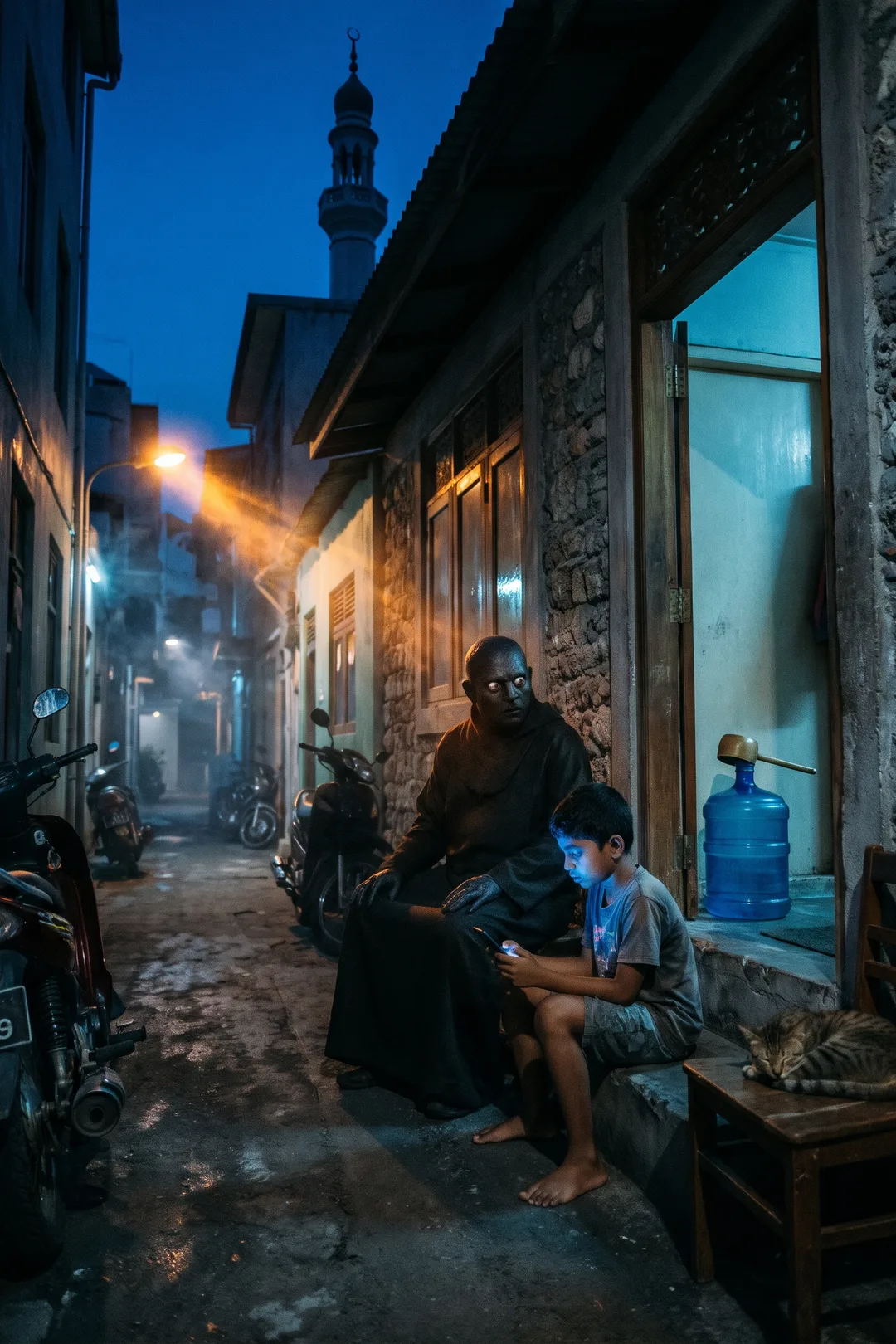
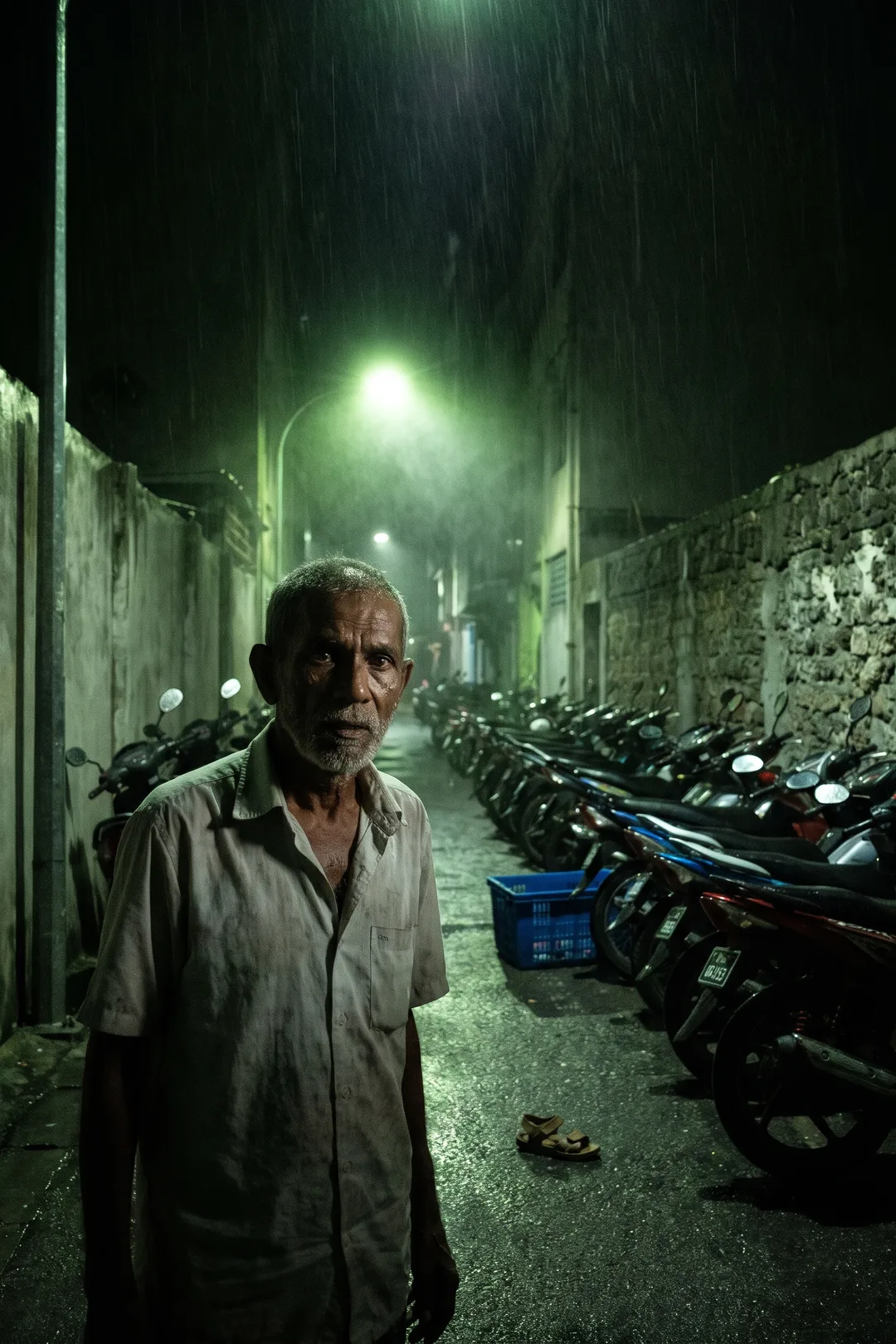
The old man said it from a doorstep halfway down the goalhi. He sat there in a faded shirt with his slippers side by side on the step below him. Shafeeu had already gone round the lane three times. The delivery box rattled on the back of his bike, the app said he was twelve minutes late for his first pickup, and both walls were lined with motorbikes parked so tight their mirrors touched. The old man reached out with one foot and pushed a blue plastic crate away from the wall. Behind it was a gap exactly one bike wide.
"Shukuriyya," Shafeeu said. He backed in, kicked the stand down and ran for the restaurant, two lanes over.
At the counter he held up his phone and the screen stayed locked. Face unlock failed, then failed again with the phone right up against his nose, so he typed his passcode. The delivery app told him his account was not recognised. "The two chicken kottu for Shafeeu," he said to the cashier, a girl he'd joked with most nights that month. She bagged the kottu and handed it across him to a rider in a red jacket who had only just walked in. Shafeeu said "Hey," then said it louder. She wiped the counter.
It was the app, he told himself, and the cashier was annoyed about something he'd said yesterday. He walked back to the goalhi, pulled his bike out of the gap and rode home with his box empty. The doorstep was empty too.
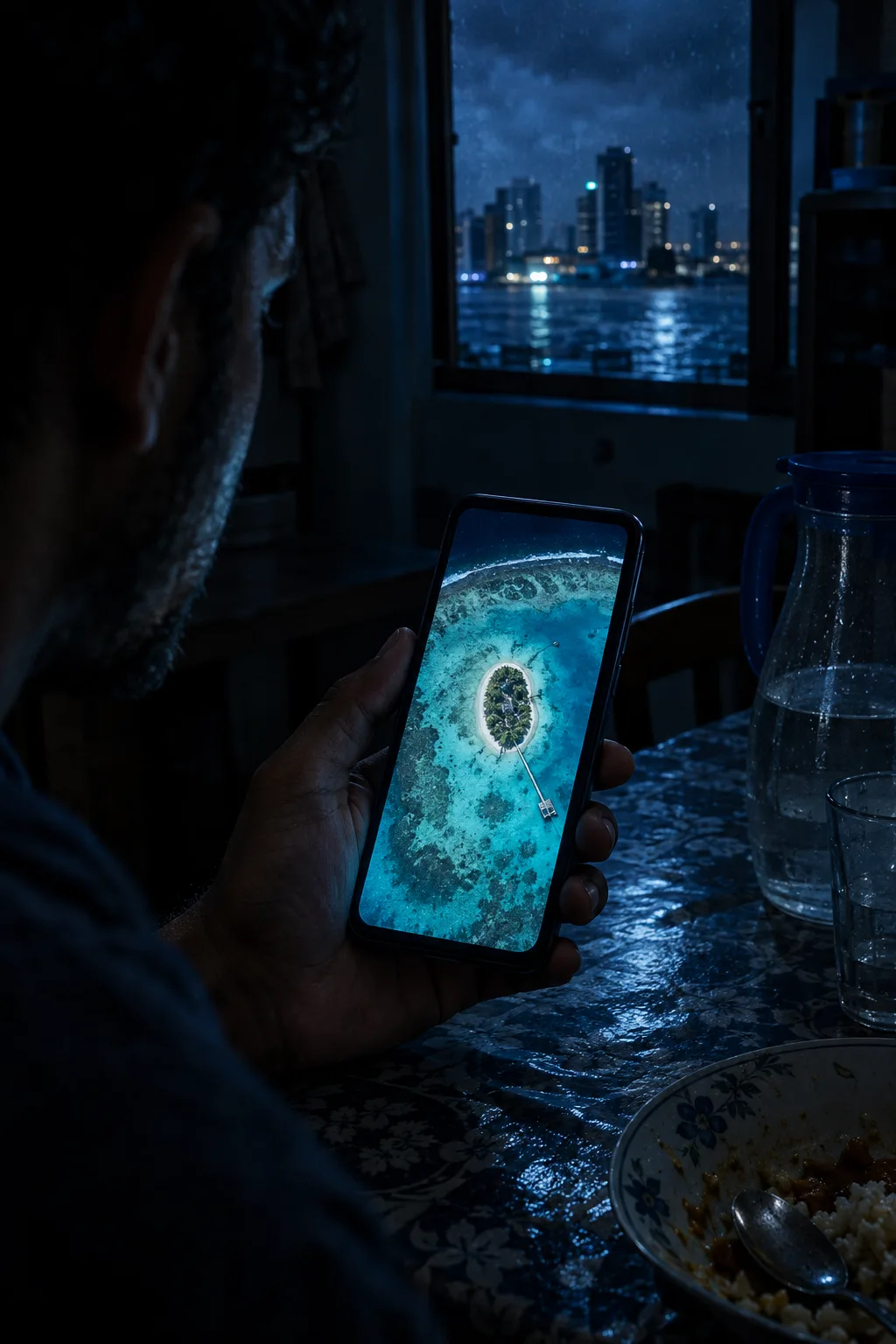
The Isha call was coming from the mosque at the end of their road when he climbed the stairs to the flat. Mama had a Dhivehi drama on and was eating at the low table in front of the sofa, rice and garudhiya, and one plate, hers. "So I'm not eating tonight?" Shafeeu said, laughing, and sat down next to her. She mixed her rice with her fingers and watched the drama. He said "Mama" three times, then shouted it, then knelt beside the television. She kept eating, her eyes on the drama.
When she had washed her plate she picked up her phone, scrolled, and stopped on a number. She looked at it with her mouth tight, the way she looked at the electricity bill, and pressed call. Shafeeu's phone was in his hand and it didn't ring. She tried again, and again, then frowned at the screen and put it face down on the arm of the sofa.
In the morning he went to Nashy's building on the next street and rang the bell until Nashy came down in his shorts, rubbing his eyes. Nashy looked at the stairs, at the street, through the middle of Shafeeu's chest. "Who is it?" he said to nobody, and shut the door. Shafeeu stood on the step and typed in the group chat: guys something is really wrong, call me, Nashy I'm outside your door. The ticks stayed grey. Further up was the photo Nashy had sent last Friday from the artificial beach, four of them waist-deep in the water with people crowded on the sand behind. Now there were three. The other two were grinning with their arms out around a stretch of empty sea, and Nashy's hand rested in the air at shoulder height, on nothing.
That night he rode back to the goalhi. The crate was back in the gap. The old man was standing against the wall beside it, and when Shafeeu's headlight hit him he looked straight back. It was the first face all day that had looked back at him.
Shafeeu left the bike in the middle of the lane and grabbed him by the shirt. It was thin cotton, soft from years of washing, and the man didn't pull away. Up close he was older than Shafeeu had thought, past seventy, with grey stubble and wet eyes.
"What did you do to me?"
"What was done to me." The old man started twice and stopped twice. "Eleven years ago. I came from the harbour, late, I couldn't find... there was a man on this wall. He said it to me. The same."
"Said what?"
"There's a space there." He looked down at the crate. "You park there, it takes your place. Your phone, your photos, your people. After that nobody sees you, only people going round looking for a space. And me, because I sent you, for a while." He wiped his mouth. "When you say it to someone else and they park, you get it back."
"You got yours back."
"Last night. When you parked." He had gone home and knocked, and his wife had opened the door and dropped the pot she was holding. His son had been fourteen when it happened. Now the son was married and lived at the end of this lane, and for eleven years had walked past this wall every morning with his own little boy. "The crate's mine. I kept it there so nobody would park by accident. I put it back tonight. I thought you'd come looking for me. Eleven years I sat here and never said it once." He was looking at the crate, not at Shafeeu. "Then you came round three times with your box and your sweaty face, and I was so tired."
Shafeeu let go of the shirt.
After that he sat on the wall beside the gap every night with his feet on the crate. When a rider slowed and looked at the gap, the rider saw him too, a young man with his feet on a crate, and Shafeeu shook his head until they went on. Early each evening he went home first and sat by Mama while she ate. She ate less. Every night she found the number and called it, five or six times, and turned the phone face down, and his own phone stayed dark in his lap. The old man came to the wall a few more nights, and each time he took a little longer to find Shafeeu's face. Then one morning he walked past the crate holding a small boy's hand, talking to him, and didn't turn his head.
After that the riders were the only people who looked at him. He started watching the corner for headlights, and when one slowed he let it sit there a while, the rider's eyes on him, before he shook his head. A boy younger than him leaned over his handlebars one night and said, "Bro, is that free or what?" and Shafeeu took so long to answer that the boy shrugged and rode on. The next evening Mama didn't call at all. She sat with the phone on her knee through the whole drama and then went to bed, and Shafeeu went back out to the wall and stayed there until the sky over the harbour turned grey.
It was past midnight, a week or more in, when a woman on a scooter came round the goalhi for the second time. Her black headscarf showed under her helmet, and the strap hung undone. A pharmacy bag swung from the handlebar. A small boy was asleep against her back, his cheek on her shirt, and she was riding one-handed with her other arm bent behind her to hold him on. She stopped beside the crate, and her eyes went to Shafeeu before they went to the gap. Then she just sat there with the engine running and her head down, too tired to go round again.
Shafeeu stood up. One of the boy's slippers was hanging off his toes, about to drop. Shafeeu sat back down and lifted his hand to wave her on, the way he'd waved off the riders. The boy stirred and said something into her shirt, and she reached back without looking and patted his leg until he settled, and her eyes closed while she did it. Shafeeu kept his hand up. He could see the boy's mouth open against her shirt. Then her eyes opened. She looked at his raised hand, nodded once as if he'd told her the space was taken, and straightened the scooter to go round again.
He put his hand down, stood, and pushed the crate away from the wall with his foot, the way the old man had.
"There's a space there."
She said "Shukuriyya" under her breath and walked the scooter backwards into the gap, careful of the boy, and put the stand down. The slipper fell off onto the concrete. Shafeeu had already backed away across the lane.
His phone buzzed in his pocket and kept buzzing. When he took it out the screen opened on his face by itself and the notifications came down in a stack: forty missed calls from Mama, the first one from the night he had parked. A man coming up the lane with shopping bags knocked his shoulder and said, "Sorry, sorry." Shafeeu laughed out loud. The man gave him a look and kept walking, and Shafeeu stood there with the phone pressed to his chest, breathing as if he'd run up all the stairs at home.
The woman had lifted the sleeping boy onto her hip and picked up his slipper, and she was holding her own phone up to her face. The man with the shopping bags walked on along the row and straight at her, and she had to step back against the scooter to let him pass. He didn't slow down for either of them. She held the phone closer, then lowered it, and looked across the lane at Shafeeu.
His phone rang in his hand. It was Mama. He turned his back on the gap and answered.
Should this become an Enigma video?
0 votes
Comments
Be kind. An editor checks every comment before it appears.
No comments yet. Be the first.