El Silbón Counts Bones on the Porch
Content note: A family member dies off the page. Alcohol.
Rafael pinched the black crust off the wick, topped up the lamp from the kerosene tin and hung it back on its nail on the corredor. He turned it low, so Tío Chucho would see the house from the terraplén on his way home. It was nearly midnight. Rain came down on the zinc roof in long rattling sheets, and beyond the lamplight the whole savanna was full of frogs. Abuela had sent him out to do it, and it was the third time that night she had asked him whether the river was over the road yet.
Chucho had taken the mare to a joropo at the pulpería, an hour's ride along the raised road, with his cuatro across his back and a promise to his sister that he'd be home before the river rose. The river had been rising since sunset; on a dry day it ran a short walk below the house, past the corral. The peones had taken the cattle to high ground, so there was nobody on the hato but the family and the three dogs asleep in the dry under the floor.
Inside, Abuela sat on her bed with the rosary moving through her fingers. Her ears had been going for years, and she talked louder than she meant to.
"If you hear whistling tonight," she said between decades, "don't trust your ears. My mother used to say, when it sounds close, he's far off, and when you can hardly hear it, he's right there."
The Silbón had been a son who killed his father, the way her own mother told it, and his grandfather had him whipped and sent out onto the plains with the father's bones in a sack. He went after men out late, drunks mostly.
"My father slept drunk in the corral one night, when I was younger than you," she said. "He came and put the sack down and started counting the bones. My mother said somebody had to listen to all of it, every bone, or he'd take more than the one he came for. She couldn't bear it, so she sent me to put my ear to the door." She moved on to the next bead. "I heard every one. They never found my father."
Just after twelve the mare came splashing up from the terraplén with Chucho singing on her back, his hat pushed back, muddy to the knees, the cuatro bumping against him and a half-empty bottle in his fist. Mamá came out in her nightdress with her arms folded.
"Look at you."
"Look at me," Chucho agreed, and held the bottle out to her. She didn't take it, but her mouth moved.
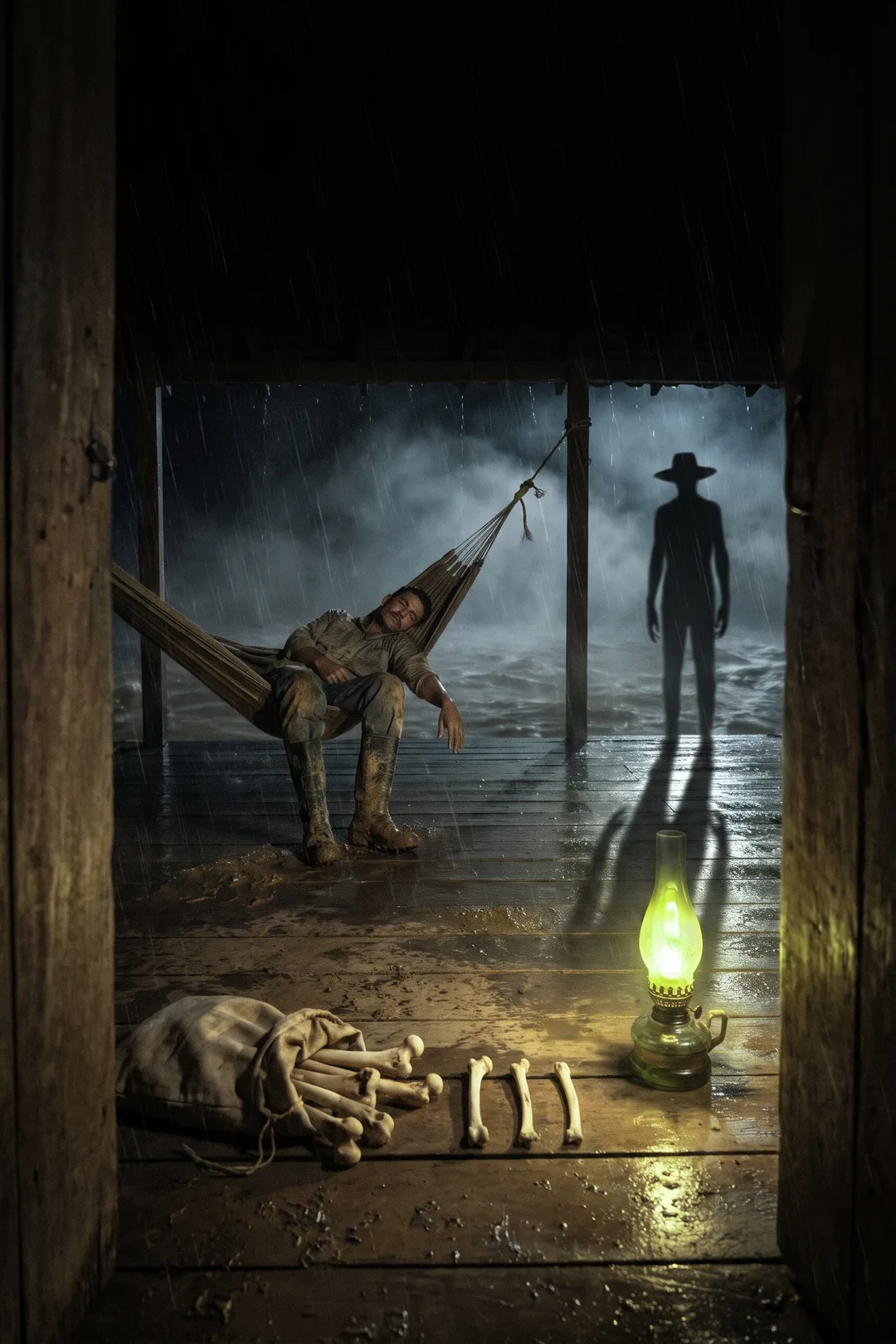
Rafael tied the mare to the post, and he and Mamá took an arm each to get Chucho through the door. He was heavy and loose and kept laughing at something, and halfway there he slapped their hands off, said he wanted the air, and dropped into the chinchorro slung across the end of the corredor. One boot swung over the edge.
"Bring him in," Abuela said from the doorway. "Drunk and out late. That's who he goes for."
"He's slept out there a hundred times," Mamá said. "The mosquitoes will sober him up." She went back out once and stood over the hammock, and he was already snoring. "He's asleep, Mamá. You'll wake the whole house dragging him." She pulled the door shut, dropped the bar across it, and they went to bed.
Rafael's cot stood against the door. There was a gap between two of the planks, and with his cheek on the pillow he could see the lamp on its nail and the long sag of the hammock under it.
He was nearly asleep when the whistle came, loud and sharp, a run of notes climbing, so close it might have been at the bottom of the steps. The frogs stopped all at once. Under the floor one of the dogs howled, short, and then the dogs were quiet.
Close means far, Rafael told himself, and lay listening to the rain on the zinc, which was all there was now. The next whistle was softer, as if it had moved off across the water. The one after that was softer again, and he sat up.
He crossed the room and shook Abuela. She sat up, saw his face and turned her head toward the door, the beads stopped in her hand.
Mamá woke at the noise and saw them. She didn't ask anything. She went straight for the bar, and Abuela caught her by both wrists.
"He's already here. It was too late for my father too," Abuela said. "Don't you open it."
"Let go of me. That's my brother."
"I can't hear a count with these ears. And you'd have that door open before he got to two." Abuela held on. "Rafa. Put your ear on the door and don't take it off. Miss one and he takes one of us."
He knelt on the cot and pressed his ear to the planks. The whistle was so faint now it could have been inside his own head. Then, on the boards of the corredor, something heavy was set down. Bones knocked together inside cloth, a dry sound, like a sack of firewood dropped. A low voice began to count, a man's voice with no hurry in it, and with each number came a small click on the wood, as if each bone were being laid down in a row.
He put his eye to the gap. The hammock rope by the post had pulled tight, the way it did when someone leaned over to talk to whoever was lying in it. Chucho's boot hung where it had been.
"Rafa?" Chucho said, sleepy and pleased, the voice he used at parties when someone came to fetch him home. He thought whoever was leaning over the hammock was Rafael.
Rafael didn't answer him. Chucho didn't say anything else.
Mamá made a sound Rafael had never heard from her. She twisted in Abuela's grip. "Open it. Rafael, open it, he's right there, pull him in."
Rafael's hand went to the bar. It was a cut beam, and he got his fingers under it and felt the weight. Lifting it and dragging a heavy drunk man out of the hammock and over the step would take both his hands, out on the corredor beside the voice, and there would be nobody left at the gap to hear the count. He took his fingers off the bar.
"No, Mamá," he said, and put his ear back on the wood.
The count went on. Between each number the pause was long enough that every time he thought it was over, and every time the next number came, and the click. Something in the sack shifted and settled. The chinchorro creaked on its hooks, slowly, as if someone were rocking it.
Behind him Mamá had stopped fighting and was crying, saying Chucho's name into Abuela's shoulder. He pushed his ear harder against the wood until it hurt.
Chucho had been snoring when it started, the loud wet snoring he always did after a joropo. Somewhere in the count it loosened into long breaths. Then the breaths came with gaps between them, and Rafael found he was waiting for the next breath instead of the next number, and dragged himself back to the voice and the click. The gaps got longer. Then there was no breathing at all, only the rain and the counting.
He heard it to the last bone. After the last number no other came. The sack was lifted off the boards with the same dry knock. Then the whistle started again, faint, and grew louder with every run of notes until it sounded as close as the yard. One frog began, and then all of them. When he turned round, Mamá and Abuela were still there behind him, holding on to each other.
At first light the rain had thinned to a drizzle and the river had stopped short of the yard. Mamá lifted the bar herself. The chinchorro hung empty and still. Chucho's hat lay on the boards under it, and the mare stood in the mud by the post, her rope still tied. Mamá looked at the hammock and then at Rafael for a long time, and said nothing. She went out into the drizzle calling her brother's name.
When the water dropped and the peones came back, they were told Chucho must have got up in the night, drunk, and walked down to look at the river, and nobody argued with that. They poled along the edges of the savanna for days and found nothing, not him and not his boots. At supper Mamá put Rafael's plate on the table and took her own to the kitchen to eat standing up. Once, scrubbing a pot, she said without turning round, "You did what she asked," and he couldn't tell whether she meant it kindly.
He took the chinchorro down, rolled it up and put it in the shed. Chucho's cuatro he kept under his cot and never played.
Should this become an Enigma video?
0 votes
Comments
Be kind. An editor checks every comment before it appears.
No comments yet. Be the first.