Holding the Ubume's Baby
Content note: A ghost of a woman who died in childbirth.
Genzō, the foreman at the porters' lodge, gave Sakichi the warning together with the box. It was raining hard that evening, and the box was a parcel of dye salts in oiled paper, promised to a dyer across the river by morning and forgotten until supper. "Take it over tonight," Genzō said around the stem of his pipe. "And on the bridge after dark, don't take anything from anyone."
Sakichi asked if he meant thieves. Genzō said he meant what he said, and went back to his pipe.
So Sakichi tied on his straw raincoat and his sedge hat, lit a paper lantern, and went out. Travellers on the old road had stopped at the inns by dusk, and in that rain nobody else would be on the bridge. The river was high and brown under it, and his wet straw sandals slid on the planks so that he walked with his feet wide like an old man. On the far bank the dyer's wife took the box, complained that it was late, and shut the door on him. He started back toward the lodge thinking about his bedding and whether anyone had left him any tea.
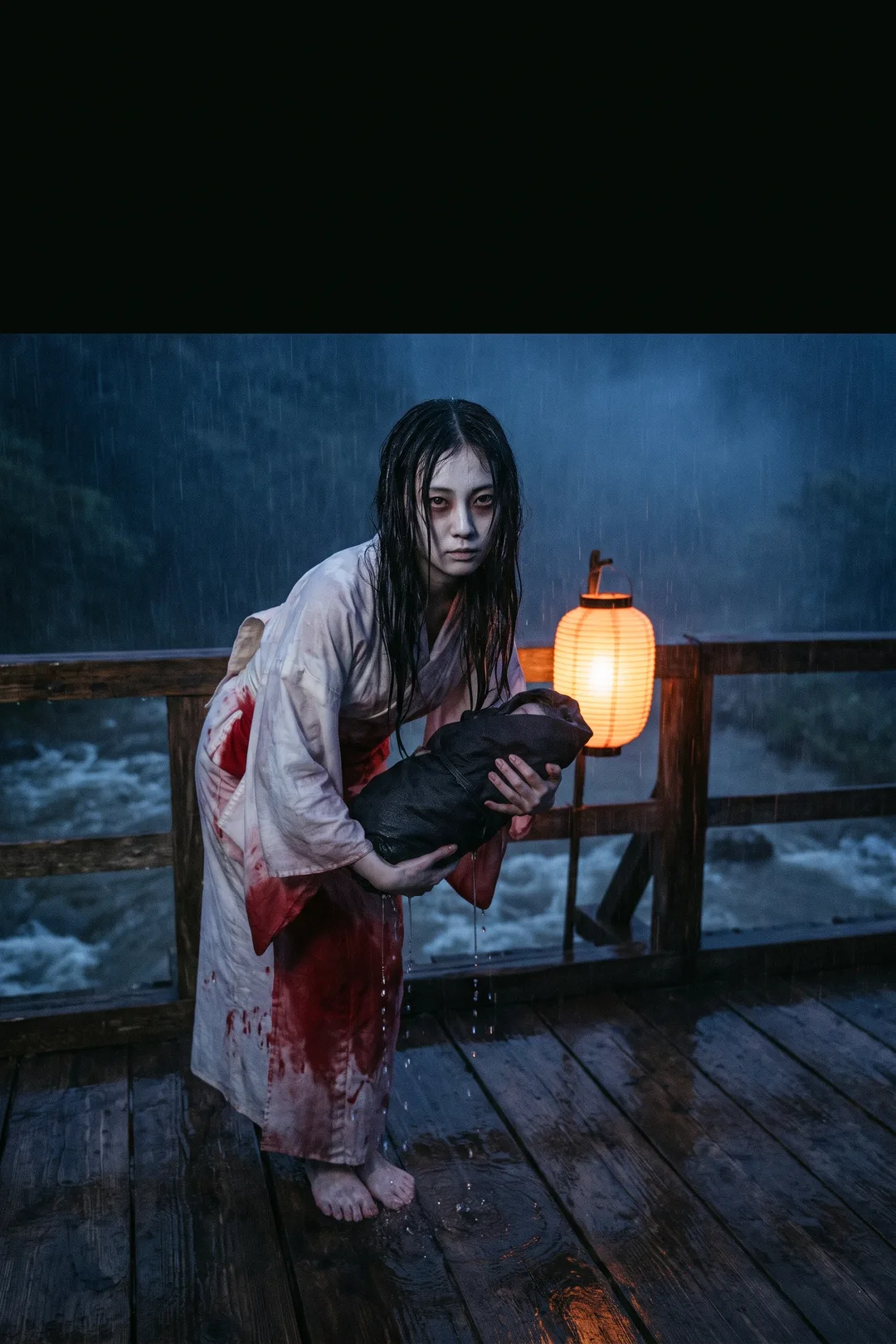
Halfway across, a woman stepped into the lantern light. She was barely more than a girl, in a white robe soaked flat to her body, and she held a swaddled baby against her chest. Below the waist her robe was dark and heavy, and the water running off her hem left dark streaks on the planks. In that light he took it for mud from a hard road.
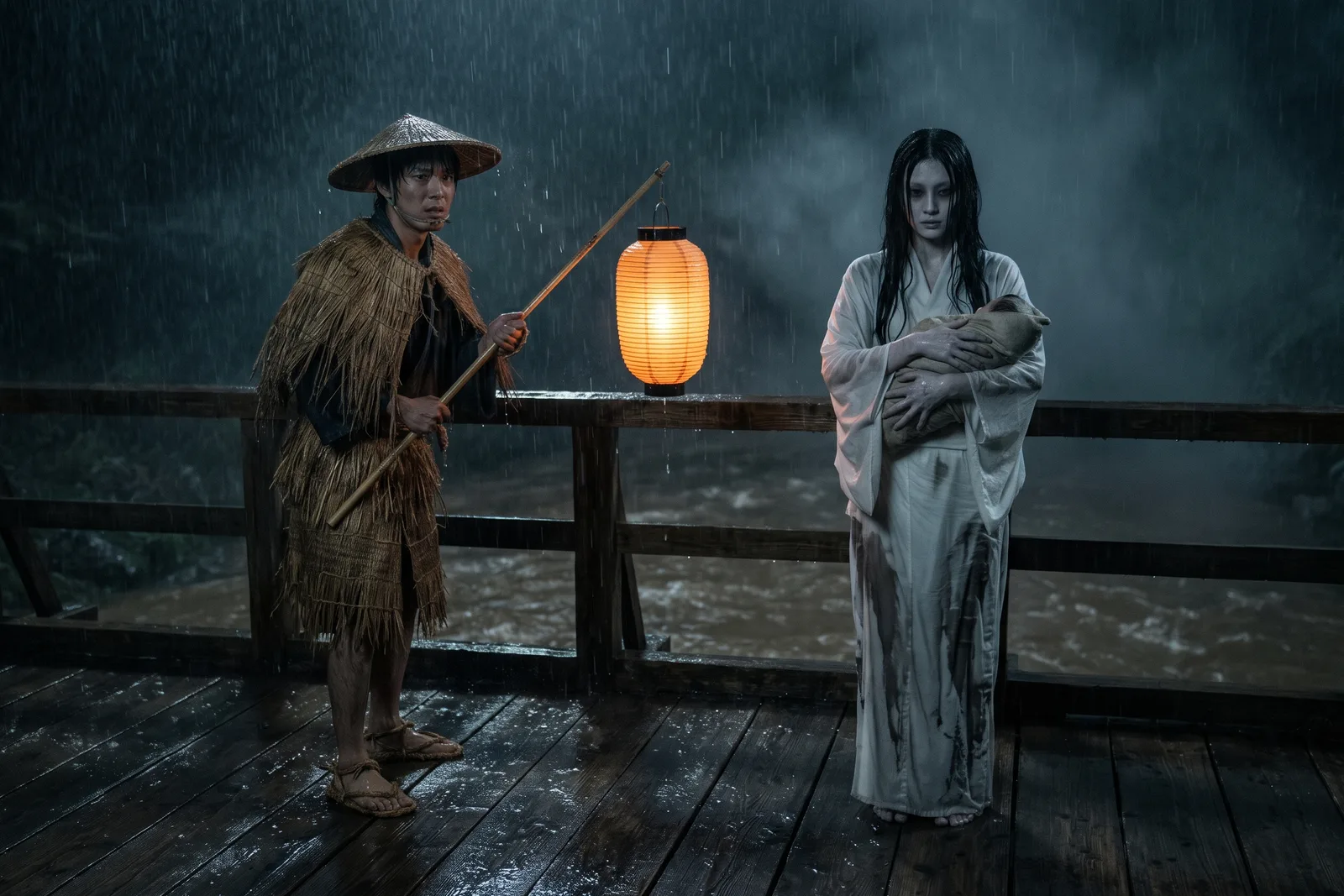
"Please," she said. "Will you hold her for me? Only until the temple bell. I'll come back for her then." She was already holding the bundle out. "Don't put her down. Not on the boards, not on the rail, not for anything, not before I come back."
He thought of Genzō. But the wrap was tied with a fat knot at the shoulder, done one-handed and wrong, the same knot his mother had used on all of them because she never had a hand free. He hooked the lantern pole in the crook of his elbow and took the baby.
It weighed no more than a melon. The woman turned and walked toward the lodge bank, and the dark took her before she reached it.
He waited where she had left him, so she would find him. The temple up the road rang the hours, and when the next bell came he looked for her. She didn't come, and he decided she must have meant a later one. The bundle was wrapped to the top, and he wasn't going to open it in that rain, but he laid his palm on it and it was warm through the wet cloth, so he let it be. It was very quiet for a baby. He jiggled it a little, the way women did at the market, and talked to it about the dyer's wife and the tea.
By the middle of the night his arms ached, and the bundle had grown heavy. It kept growing, slowly, until it sat in his arms like a bale of rice. He laid the lantern pole down on the planks to get both arms under it and shouted for the woman, toward one bank and then the other. Nobody answered. The baby didn't cry, not even at his shouting.
The rail was right there at his hip. He could rest the bundle on it for a moment and take the strain off his back. He looked at it for a long time and didn't do it, because she had said not on the rail, and because if it was a baby, a rail over that water was no place for it.
The lantern guttered and went out. In the dark he thought of the streaks on the planks, and it had not been mud on her robe. His mother's story came back to him, the one she told when the lamp was out to keep them in their bedding: the woman who died with her child and waited by the water at night for a stranger to hold it. He couldn't remember how it ended. He could still drop the thing on the boards and run for the lodge.
But she had asked him, and there had been nobody else on the bridge to ask. He got down on his knees on the wet planks, pulled the bundle in against his chest with both arms locked around it, and began to say the nenbutsu. Namu Amida Butsu. Namu Amida Butsu. He said it so that his arms would stay shut.
The weight went on growing until it was a millstone. The planks creaked under his knees. He bent forward over it, and something in his side gave with a small dry crack, and after that he couldn't fill his chest enough to pray out loud. He moved his lips around the words. The night bells came and went. His knees had gone past hurting into a burning he could hear in his own breath.
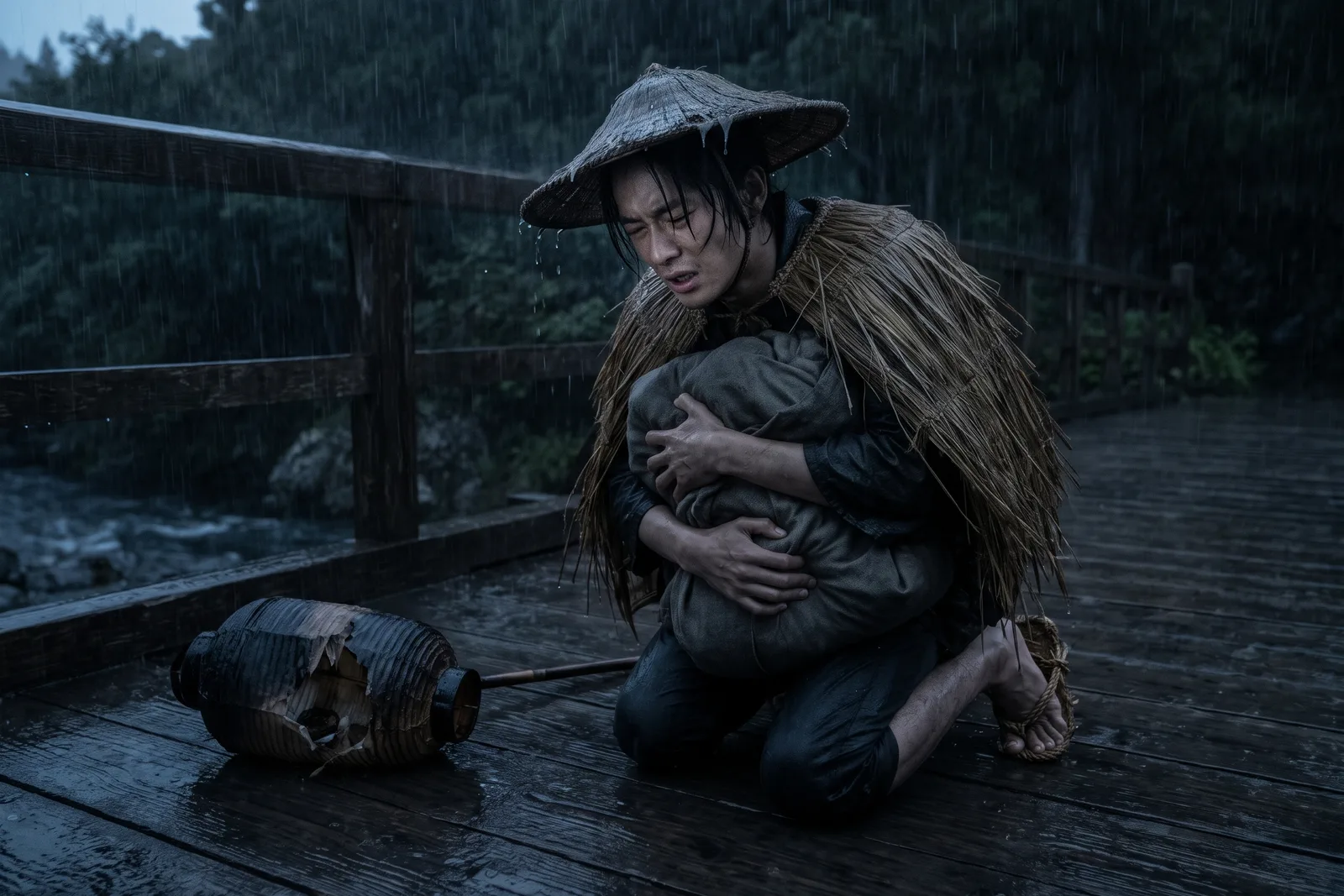
Some time after that his left hand cramped shut on the cloth and then went dead, and he could no longer tell whether he was holding the bundle or only leaning on it. It slid. It went down his thigh toward the boards, and he caught it on his knee a finger's width above the wet wood and stayed there with his whole back shaking, working his arms under it again a little at a time. After that he didn't dare shift at all, not even to get the rain out of his eyes.
The rain thinned and stopped. The planks went from black to grey under him. He kept his eyes shut and held on until the dawn bell rang from up the road.
When he opened his eyes, the woman was standing over him. She bent and lifted the bundle out of his arms as easily as she had handed it to him, and the wet cloth fell open between them. Inside was a smooth grey river stone, the size of a baby's head. She bowed her head to him once, the way a woman thanks a neighbour at the door, and held the stone against her chest as she had held the baby. Then the bridge was empty.
It took him three tries to stand, and he limped to the lodge end of the bridge, holding the rail. On the bank there, where she had walked off into the dark, a few steps above the water, there was a small plank roof he had walked past a hundred times, and he had always taken the thing under it for a dyer's rag left on a frame. This morning he stopped. A red cloth hung between four bamboo poles, with a wooden marker beside it. There had been one like it at the ford in his village, the year the carpenter's wife died with her baby, and his mother had poured a ladle over it whenever she passed and made him do it too. Nagare-kanjō, she called it, and said the water was so the carpenter's wife wouldn't have to wait by the river. Nobody had poured over this one in a long time. The sun had faded it to the colour of a dried persimmon, but the sutra lines on it were still dark, and under its roof the cloth was bone dry. A wooden ladle hung from one pole, cracked from years of sun.
He took the ladle down to the river, filled it, carried it back up held level, and poured. It darkened one corner. He went down again, and again, his ribs catching every time he bent, until the cloth hung dark and dripping. Then he told her, out loud, that he would come every morning until the colour was gone and the cloth wore through.
At the lodge Genzō looked at his face and said, "So she asked you." He bound Sakichi's ribs with a strip of old cloth, and while he was pulling it tight he said she had asked him too, his first winter carrying. He had put the baby on the rail and run, and he hadn't crossed that bridge after dark since. When he went back in daylight the rail was empty, and she had never once asked him again.
Sakichi limped for weeks. On the third day he bent to a rice bale that two men usually shared, lifted it by himself, and stood there holding it, and remembered how his mother's story ended, what the woman by the water gave to whoever held on.
Every morning after that, before the first loads, Sakichi carried a bucket up the bank and ladled it over the cloth. The bucket never felt heavy. Genzō grumbled that he'd be late. One morning in the cold months he walked out after Sakichi without a word, took the ladle from him, and poured.
The red went slowly. By the second rainy season it was the pink of a peach skin, and by the fourth the sutra lines had gone brown and blurred, and on bright mornings Sakichi could see the river through the weave.
Should this become an Enigma video?
0 votes
Comments
Be kind. An editor checks every comment before it appears.
No comments yet. Be the first.