Paree Fengandu - The Fairy Pond in Laamu Gan of the Maldives
"If anyone calls you from Paree Fengandu, you don't answer. Not yes, not who is it, not even to say your own name, and not if it's my voice either."
Maama said that to every child in the family before she let us out to play on our own, and she said it to Ibrahim while he was still on her hip. I thought it was her way of keeping small children out of deep water. The pond sits in the trees on Gan, in Laamu Atoll. People say a paree lives in it, a spirit of the water, and that it has no bottom.
That month Mum and Dad were in Malé for Dad's back surgery, so I walked my little brother home from school, shouting "Ibrahim, come on, Maama's waiting" across the gate every afternoon, and Maama cooked. Ibrahim was nine and thought about nothing but cricket, and he missed Mum badly, though he'd have hit you for saying so.
On the Thursday, just before Maghrib, he came in through the yard with two of our cousins, and his face was a colour I didn't like. They'd hit the ball into the trees near the pond. The older cousin said Ibrahim went after it and kept going, straight into the mangroves, and they'd had to drag him back by his shirt.
"Mum was there," Ibrahim said. "She said, Ibrahim, come here, I'm back."
"She's in Malé," I said.
"I know." He said it like that didn't matter. "It was her."
The cousins hadn't heard a thing. Maama had been listening from the kitchen door. Her hand went to the frame and stayed there. She walked the cousins home herself, and when she came back she told me nobody was to say a word to Mum, not with Dad going into surgery on Saturday.
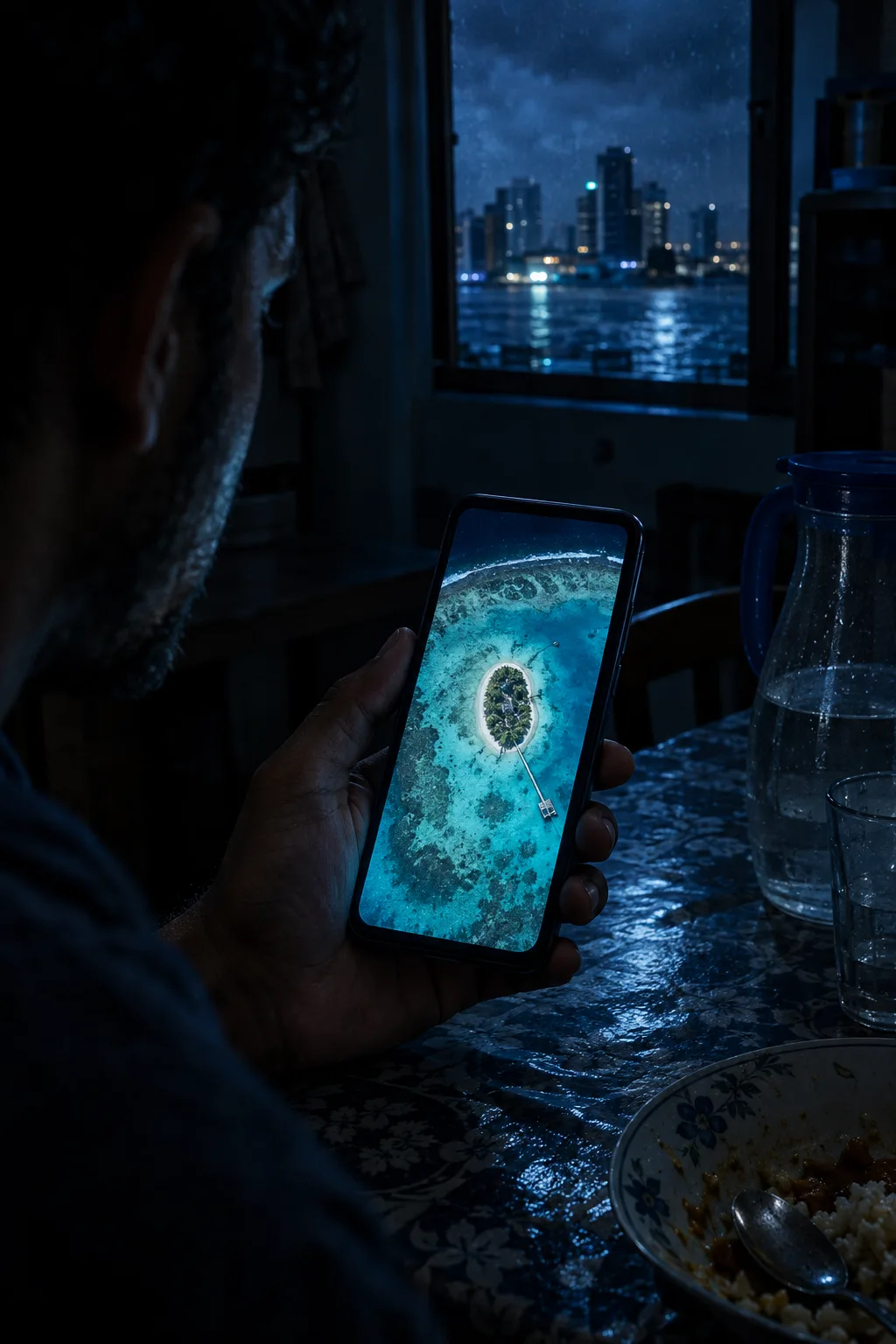
I video-called Mum anyway, so he could see her. She answered from the hospital corridor with her shawl pulled crooked and a flask of tea under her arm, and she told him to eat his rice and be good for Maama. He nodded at the screen. When she'd gone he said, very quietly, "She sounds wrong on the phone. At the pond she sounded right." Maama heard that from the kitchen and took the phone out of my hand, and said no more of Mum's voice in this house until it was over.
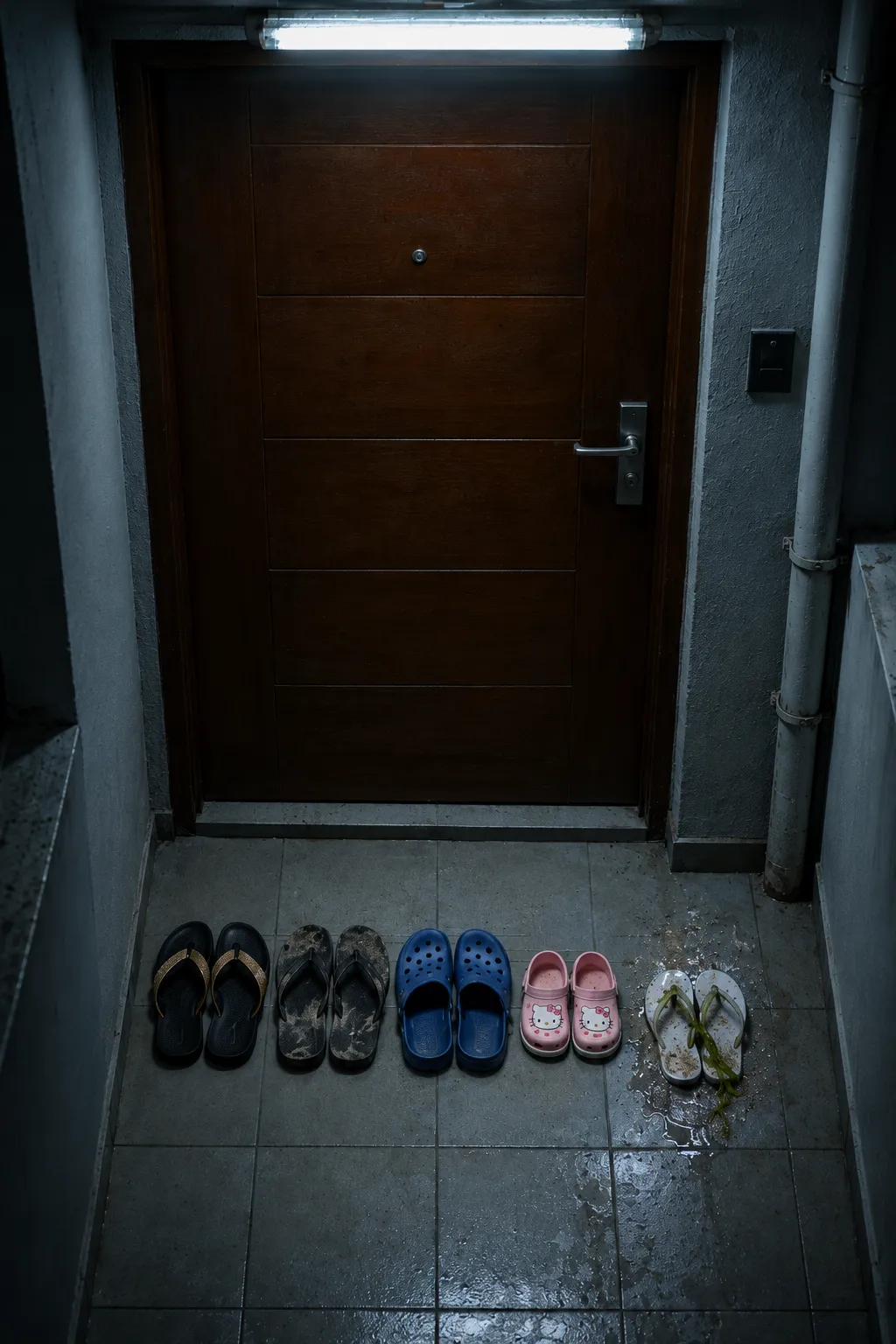
At two that night the fan stopped, and I went for water and found him at the front door with his slippers on and his hand on the bolt. His eyes were open. "Mum's waiting," he said, like I was being slow.
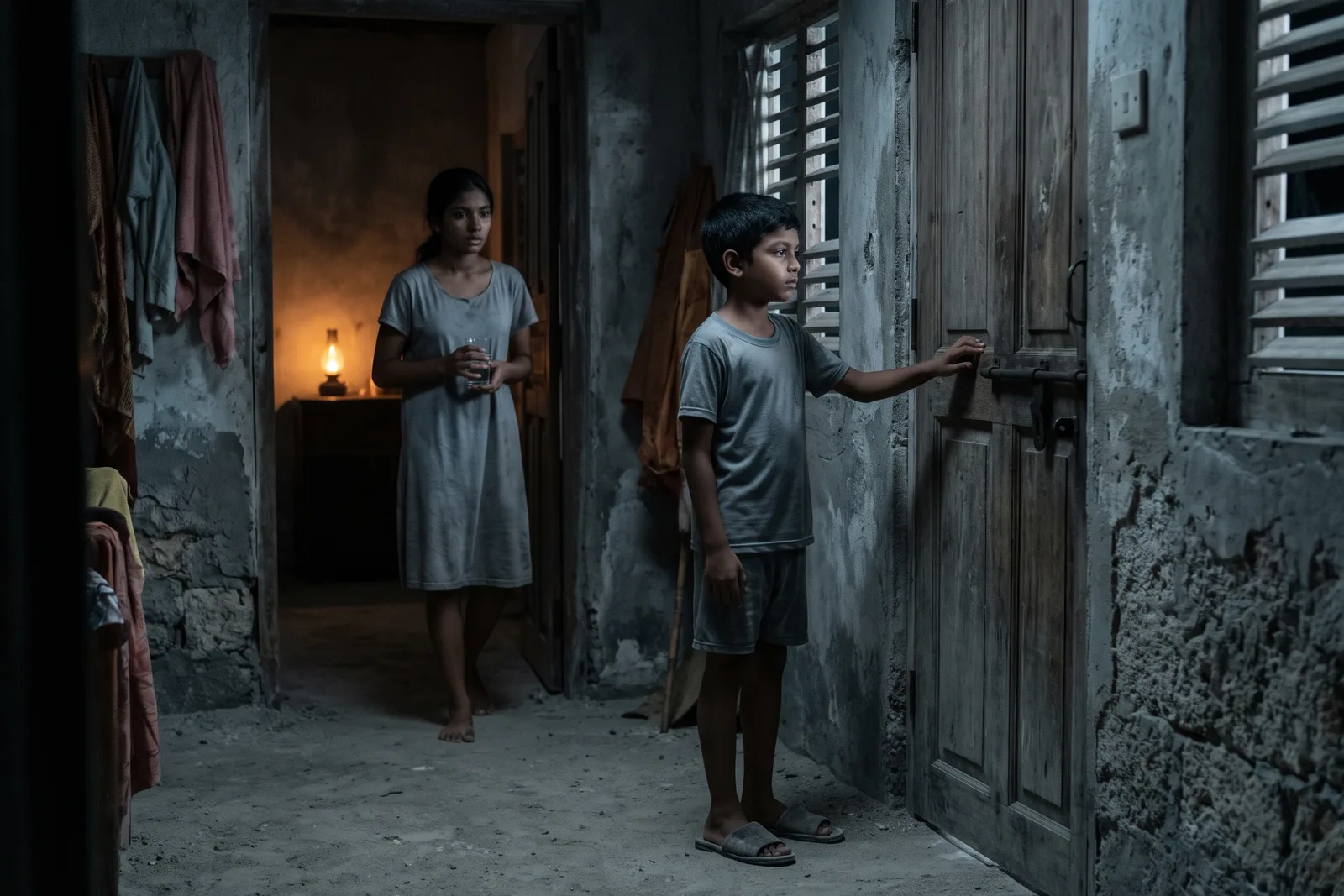
I got him back to bed and shook Maama awake. She listened sitting up on her mat, and she didn't tell me it was a dream. She pulled her shawl round her and told me about her sister.
Hawwa was three years older than Maama. When Hawwa was twelve she heard their mother calling her from the pond, though their mother was at home grating coconut, and Hawwa called back, Here I am. She came home that evening and never said another word, not one, for the rest of her life, and she lived to be an old woman.
"It calls in a voice you love, and it keeps calling until somebody answers out loud," Maama said. "Whoever answers gives it their voice. My grandmother told us that, and she said it doesn't care whose mouth, so long as somebody answers." She looked at the door. "After Hawwa it went quiet for a while. Then, whenever I went near those trees, it called me in Hawwa's voice, the way she sounded at twelve. I never answered it, and my father never let me go that way again." She took my hand into her lap. "If it comes to anybody answering for him, it will be me."
She sat in the front room and recited Quran until the call to Fajr, steady and low, then put her mat across Ibrahim's doorway and slept there. After Friday prayers the imam came to the house and read in Ibrahim's room, and told Maama what she already knew: keep reciting, keep the boy home.
That night her knees were too bad for the floor, so I sat on the end of Ibrahim's bed with my knees up, so I'd feel him if he moved and could shout for Maama, while she recited in the front room. I hadn't slept properly since Thursday. I didn't mean to close my eyes. I woke with my neck bent, the window wide open and his sheet thrown back, and in the front room Maama was blinking at her open Quran, with no idea when she had stopped.
I screamed for her and didn't wait. I took my cousin's bicycle from the yard wall and rode it down the dark road with no light, the tyres slipping in the sand, Maama behind me shouting for me to wait while she came on foot as fast as her knees would let her.
I dropped the bike where the trees start and pushed in. Branches caught my hair. The ground went soft, and the air smelled of rotting leaves and something sweet, like a mango left too long in the sun.
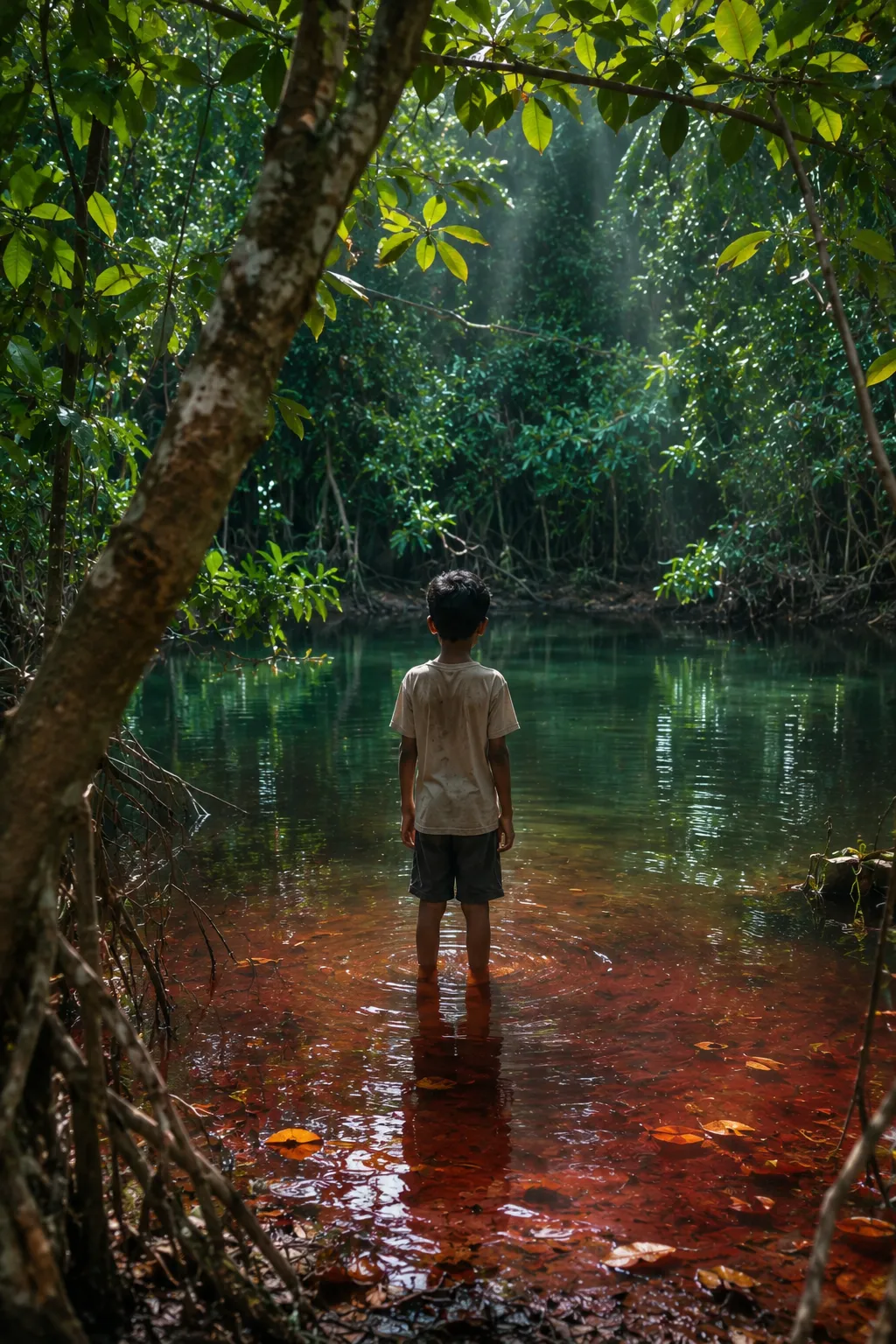
The pond was completely still. At the shallow edge it was red from the leaves that rot in it, the colour of tea left too long, and further out it went black-green and flat.
Ibrahim was standing in the red part up to his shins. He was barefoot. His arms hung by his sides.
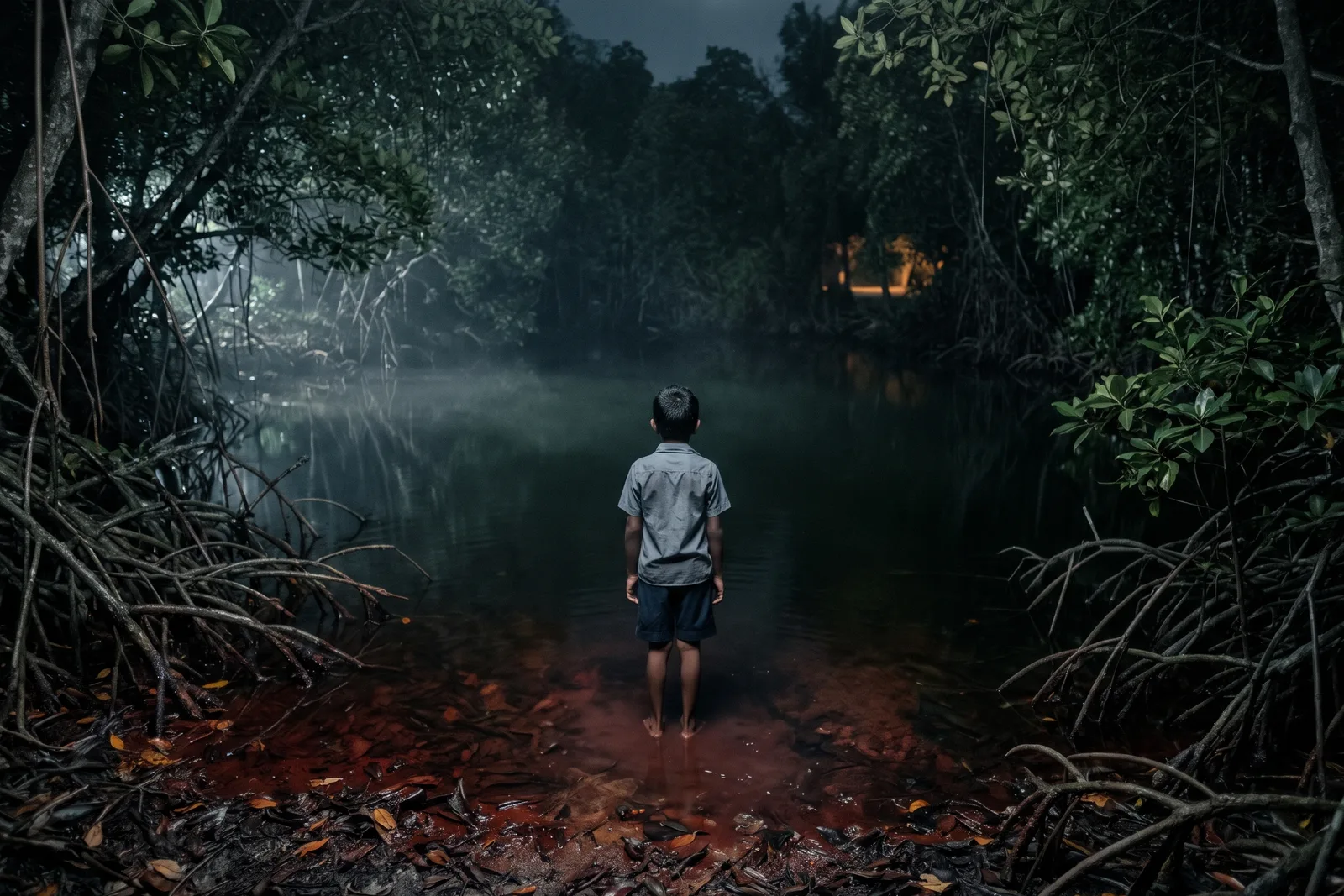
Then I heard it too. From the middle of the water, Mum said, "Ibrahim." Patient, warm, the way she says it when she's found him hiding. And then the little cough she does before she says anything important, the one she's had since I was born. "Ibrahim, come here."
His mouth opened. A sound started in his throat, the beginning of a word, and he swallowed it, and it started again.
I went into the water. It was warmer than it should have been, and the bottom gave under my feet. I got behind him and put my hand flat over his mouth.
He fought me. He's small but he twisted hard, and he bit the meat of my palm hard enough that I felt his teeth meet, and under my fingers I felt him get out the start of it, "Mu," hot against my skin.
"Ibrahim," Mum's voice said. Closer now. It wasn't in a hurry.
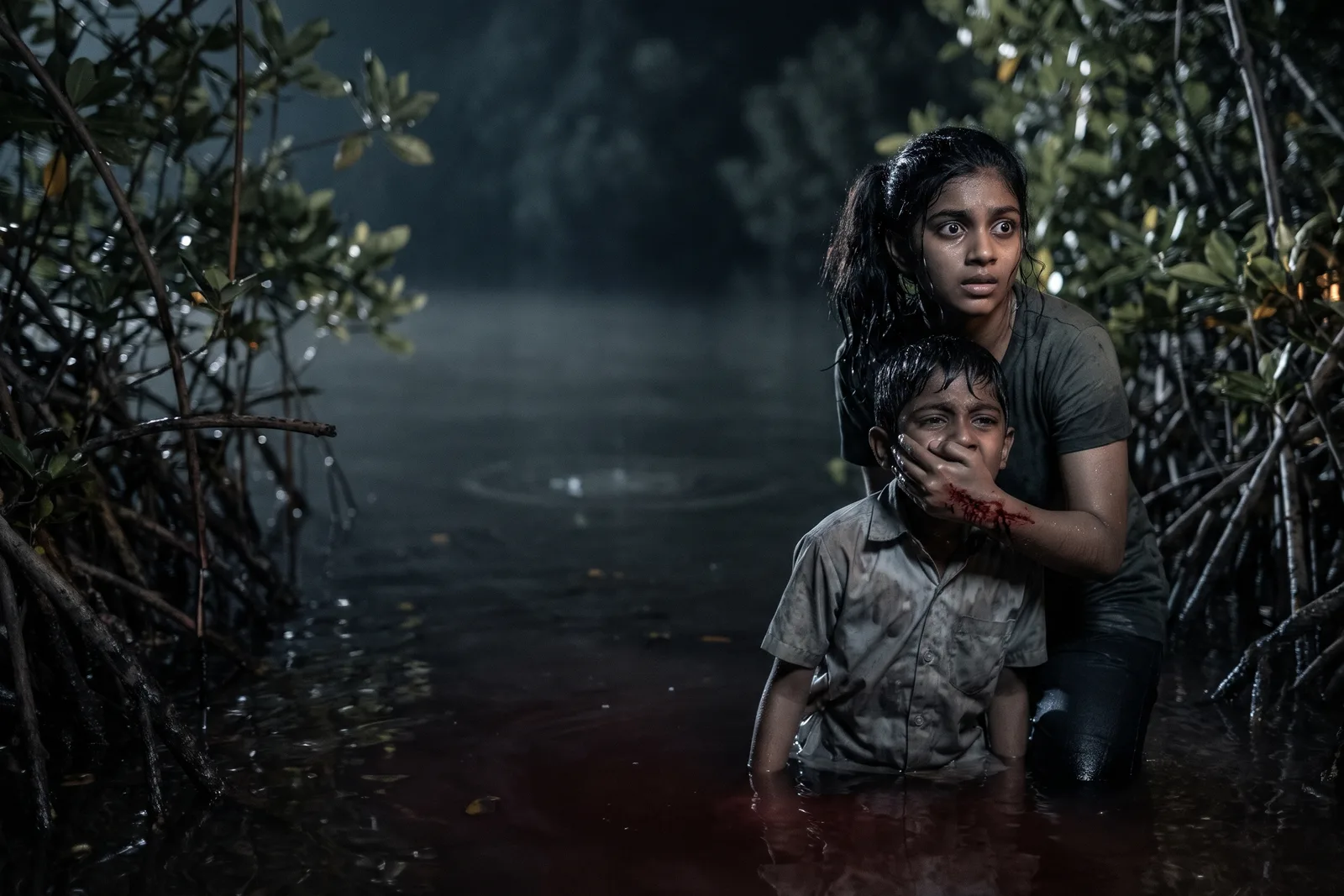
Somebody, Maama had said. It doesn't care whose mouth. I thought about Hawwa sitting in a kitchen for the rest of her life without a word, and about Ibrahim at nine never telling anyone anything again. With my hand still clamped on his mouth and the blood running down my wrist, I said it out loud, to the middle of the pond.
"Here. I'm here."
A single ring went out across the black water and reached the red edge and touched my shins. The calling stopped. Ibrahim went loose in my arms and started crying, an ordinary crying, and I tried to say his name and nothing came. My mouth made the shape. My throat did nothing at all.
Maama reached the edge of the trees then. She saw my face and sat down on the mud and put her hand over her eyes. "That was mine to give," she said. "I was coming to give it."
I stood in the water holding Ibrahim, so angry with her for being slow that I shook, and so glad of it that I was crying, and I couldn't make a sound for either.
In the morning Maama took me to the health centre. The doctor looked down my throat, found nothing wrong and said it was shock. That evening, once Dad was out of surgery, Maama phoned Mum in Malé and told her that Ibrahim had walked in his sleep and got out through the window, and that I'd found him at the pond and had a fright and lost my voice. Two days later, as soon as Dad was stable, Mum flew home, and Dad stayed in Malé to recover. Mum held my face in both hands in the kitchen and asked me to just try, just one word, and I typed I can't on my phone and showed her. That night I heard her asking Maama, low and sharp, why the window had been open, and Maama gave the same answer again. After that Mum checked every window bolt herself before bed, twice, and never said why. The next month she took me to a specialist in Malé, who put a camera down my throat and found nothing either.
Ibrahim wouldn't look at me. He moved his mat into Maama's room, and when I came into the kitchen he found a reason to go out to the yard. Maama recited every evening after Isha, and the nights stayed quiet. "While Quran is read in this house it can't pull him," she told me once, "but outside these walls it can, and it hasn't forgotten him." I went back to school and wrote my answers in my exercise book, and by the end of term the teachers had stopped calling on me.
One evening at Maghrib Ibrahim didn't come in from cricket. Mum, who still thought it had all been sleepwalking, had let him out with the cousins as long as they stayed in the road. She was at the shop and Maama was washing for prayer, so I went out to fetch him. The cousins were still in the road, and the older one pointed past the last houses and said the ball had gone over toward the trees, and Ibrahim had gone after it before they could grab him.
I ran. The open ground there is sand and scrub, and it was nearly dark. Ibrahim was standing at the far side of it, just short of the trees, with his back to me and his bat hanging from one hand.
From inside the trees, I said, "Ibrahim, come on, Maama's waiting."
It was my voice from before, a bit bossy and out of breath, exactly how I used to shout it across the school gate.
Ibrahim took a step toward it. I opened my mouth to shout his name and nothing came, not even air with a shape to it. He took another step. I ran across the sand with my slippers coming off and caught the back of his shirt just as he reached the first branches, the way the cousins had that first Thursday.
He spun round and saw me. He looked at my face, then at the trees, where my voice was still saying, "Come on, Ibrahim, don't be slow," and then back at my mouth, which was shut.
"That's you," he whispered. "That's how you say it."
I shook my head and pulled. He dropped the bat and came, and halfway across the sand he took my hand and held it so hard it hurt where his teeth had been.
Behind us, in my voice, it kept calling him all the way to the last house. It wasn't in any hurry.

Should this become an Enigma video?
0 votes
Comments
Be kind. An editor checks every comment before it appears.
No comments yet. Be the first.