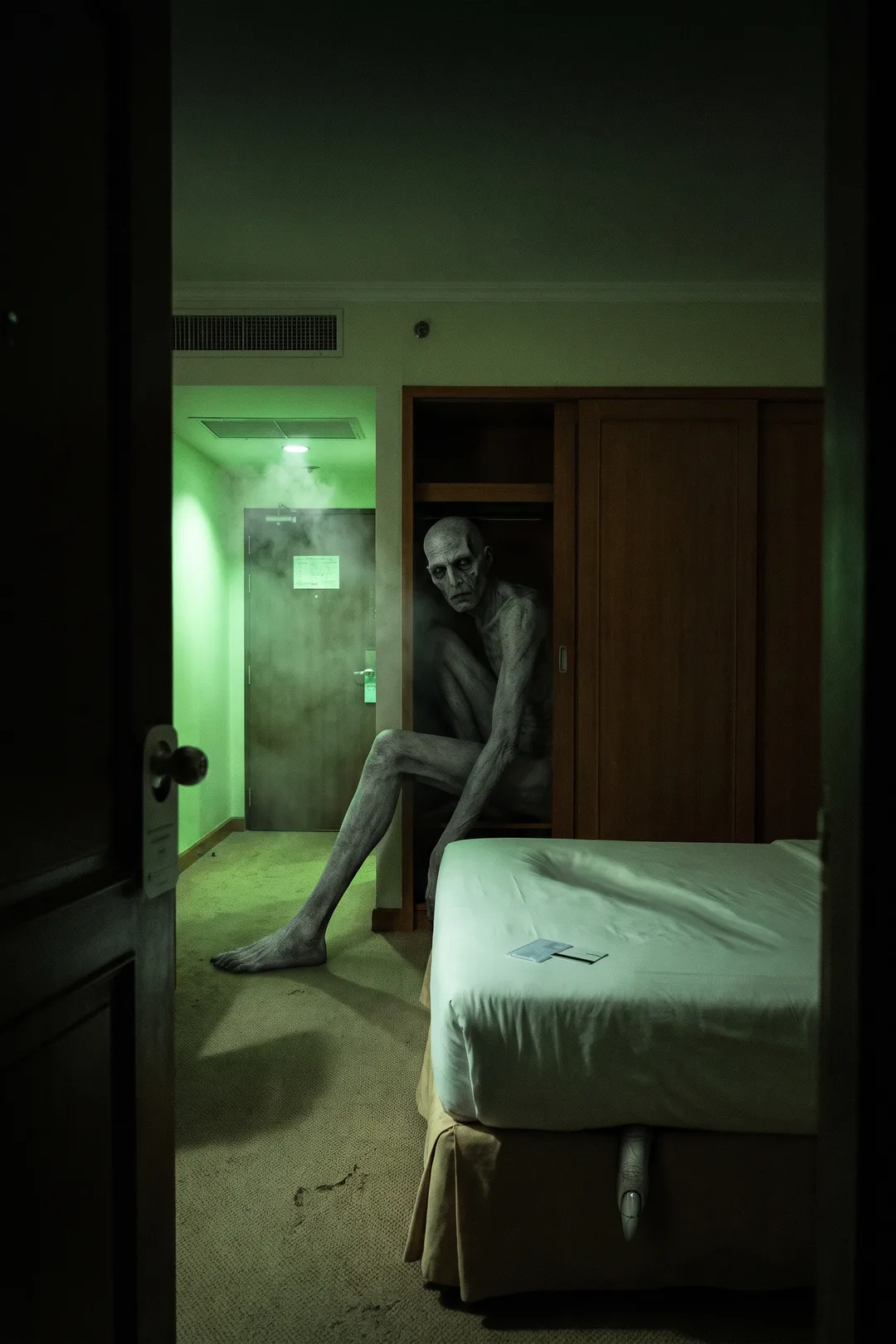
The Warm Seats of the Manila Film Center
Mang Dado gave Rico his one rule at the guard post off the lobby, on Rico's first night, somewhere between complaining about his knees and complaining about the coffee. "Puro asukal, this 3-in-1," he said, and pushed the cup away from the little Santo Niño on the desk. All sugar. "Listen. In the big theatre, never count the seats. If you count them, you're counted with them."
Then he handed over the flashlight, the logbook and the ronda key on its lanyard, and called Rico iho, the way the older guards called all the young ones the agency sent. Rico laughed a little, to be polite.
Mang Dado didn't laugh. The guards here told a story, he said, from before his time, about a new guard, a boy from Samar, who counted on his first night to show he wasn't scared. He finished his shift fine. The next night he went in on the 3 a.m. round and didn't come out. They found his flashlight on a front-row seat. "Sabi nila, when the floor fell in '81, at night, the work didn't stop." They say. "Some say thirty men, some say more than a hundred. Nobody wrote it down. Never dug out, they say." He crossed himself and went back to his pandesal.
Rico had asked the agency to send him here because of his Tito Ambo, and he hadn't told his Nanay in Tondo. Ambo, Nanay's younger brother, had written home in November 1981, twenty-five years before, to say they'd put him on night shift at the Film Center and everyone was rushing to finish before the festival in January. That was the last letter. No body came home. All the family was ever told was that Ambo had left the job, and Nanay never believed it. Every year at All Souls', lighting a candle with no grave to put it on, she still asked nobody in particular, "Ilan kaya sila?" How many were they. Rico had only wanted to stand where Ambo had worked. He didn't tell Mang Dado any of that.
The big theatre was the last station on the round. On the 11 p.m. pass, one seat in the middle of the house was folded down, alone among hundreds of upright ones. Rico went along the row and pushed it up. It stayed up, the hinge stiff and quiet. He wrote "loose spring, row M" in the log.
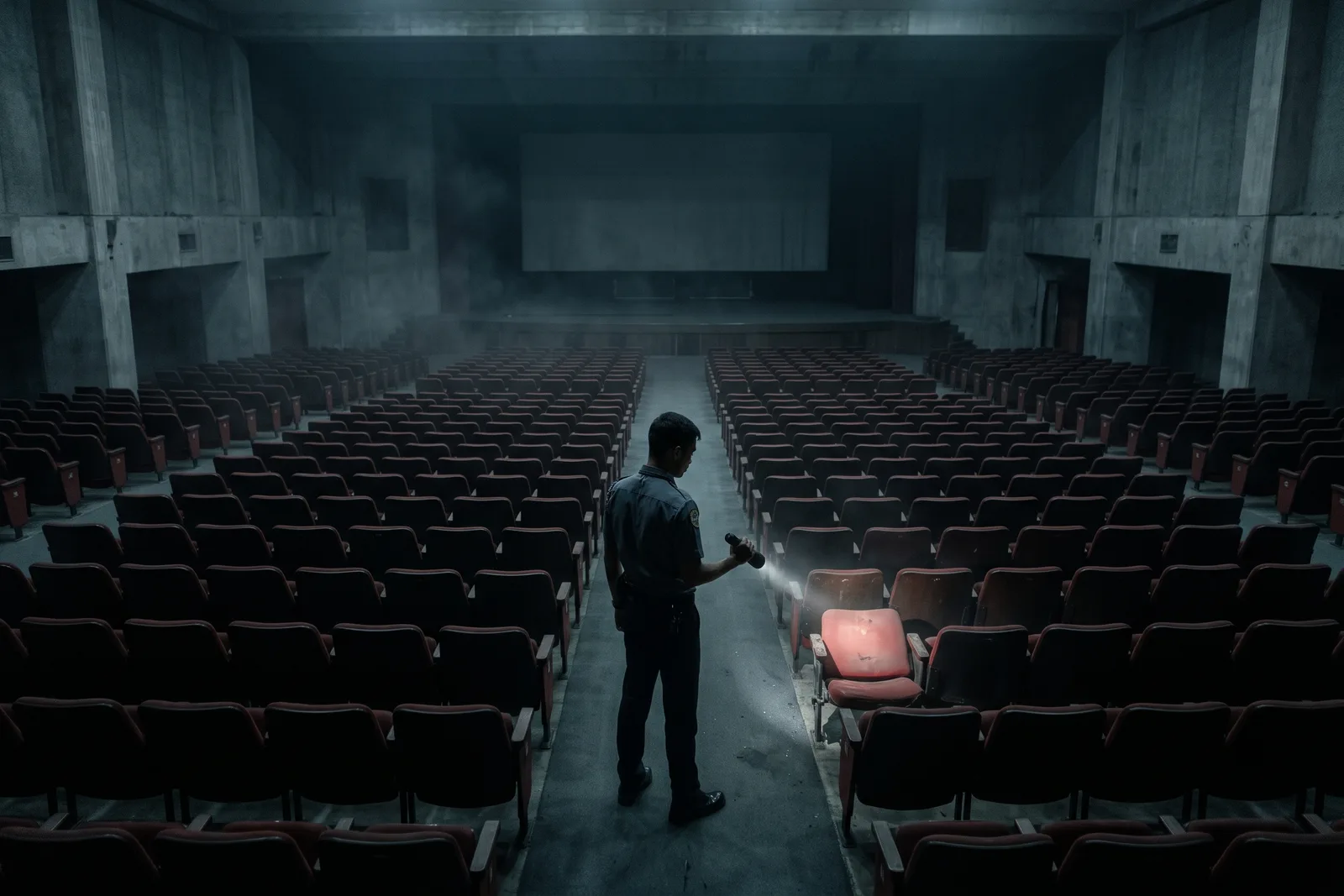
Back at the post, Mang Dado read the entry and stopped chewing. "Walk the aisle, press the station, get out. And don't count. Okay?"
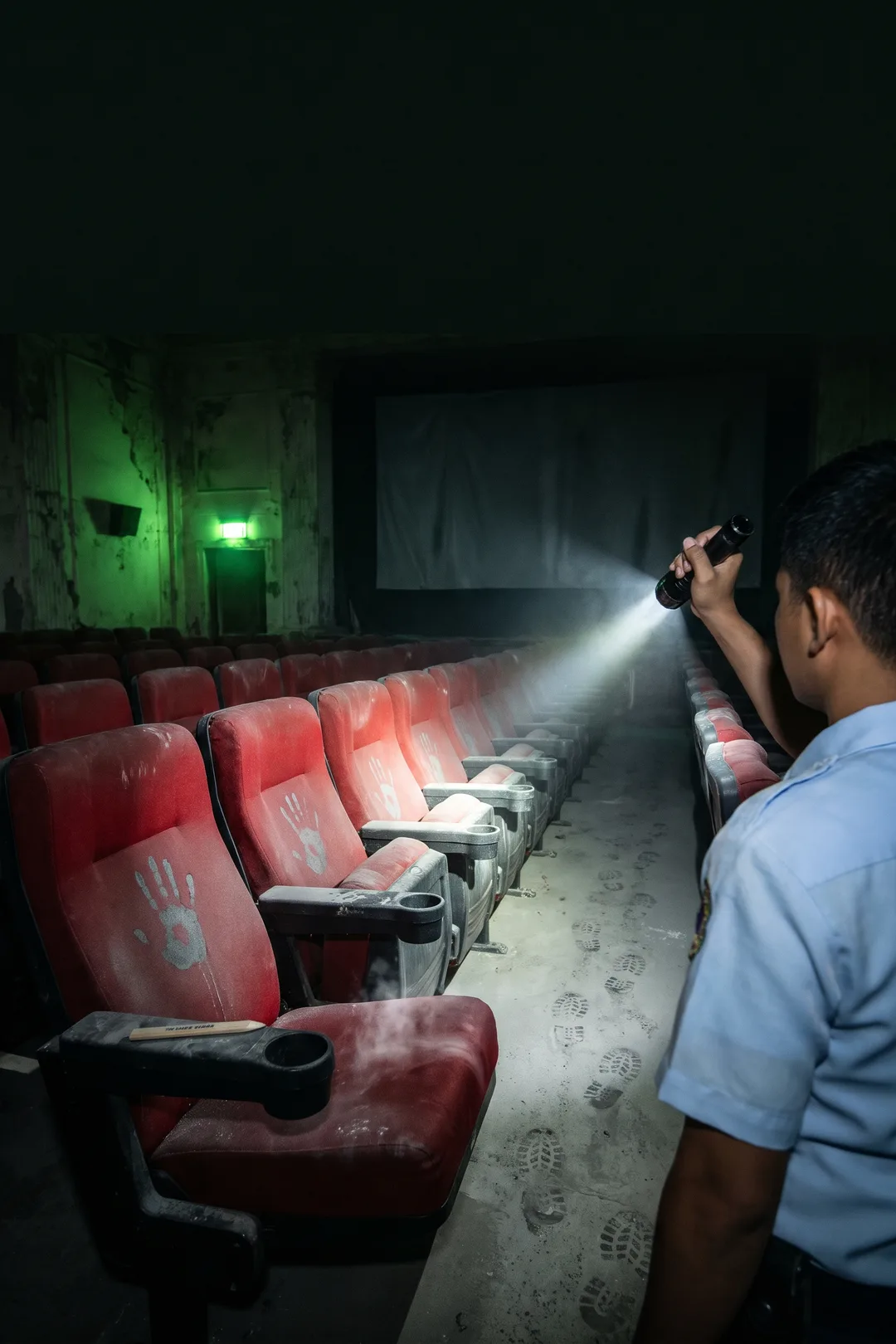
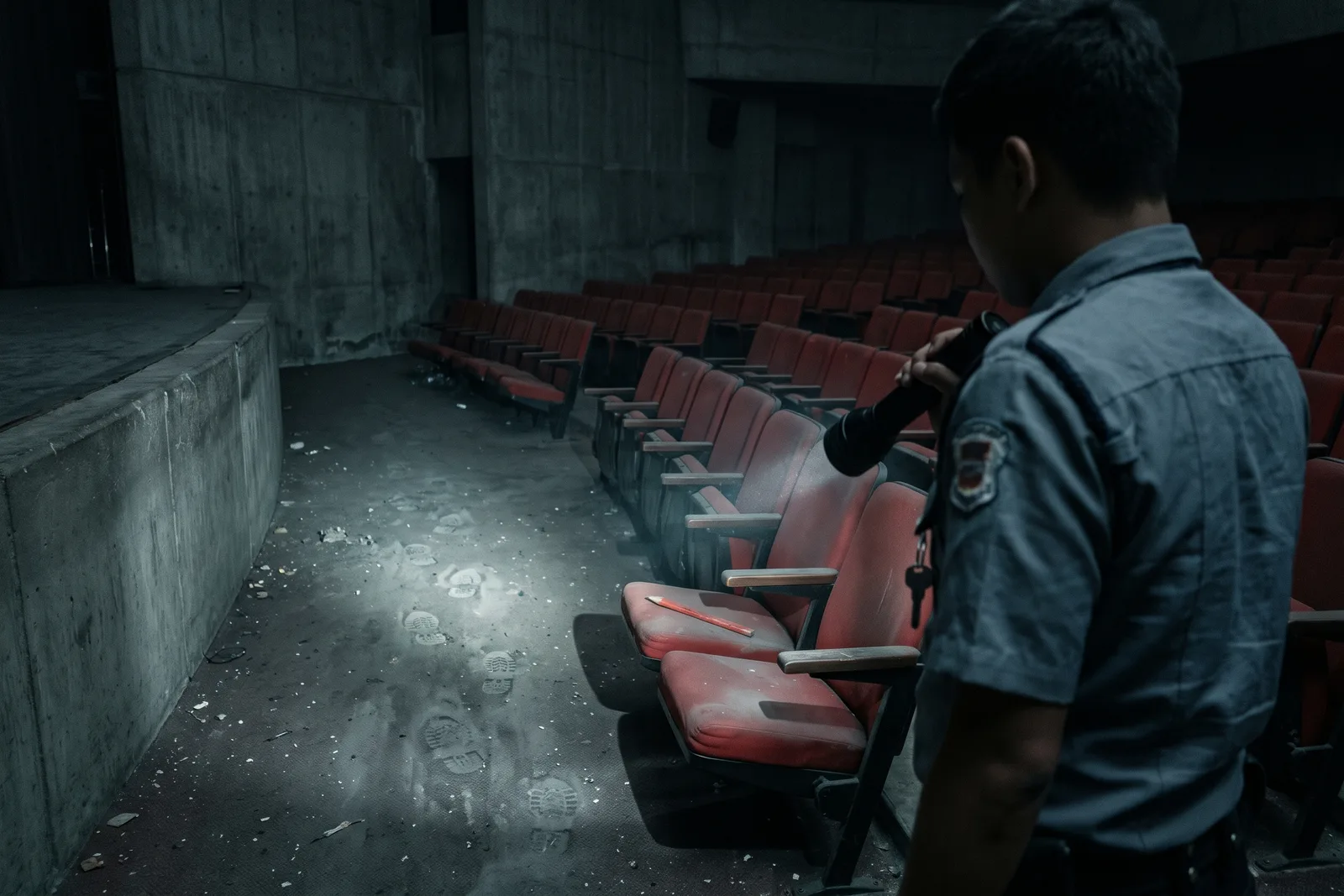
At 1 a.m. there were three, scattered across the middle rows. Rico put his palm on the nearest cushion and took it straight off again. It was warm, like someone had just stood up. On the armrest was a handprint in grey grit, dry and fine, the kind that came off his fingers when he touched it. Cement dust. All three had one.
He radioed. Mang Dado came as far as the theatre doors and no farther, his flashlight pointed at the floor. He made the sign of the cross and said, "Tabi-tabi po," to the dark, the way his own lola must have taught him.
"Can I skip this station?" Rico asked. "Just tonight."
"The clock records every station. You skip, they write you up, and you're still on probation, iho. One missed round and the agency doesn't keep you. And it's only us two on nights. The supervisor doesn't pick up after twelve." Mang Dado rubbed his knee. "I'm sorry, iho. I need the money too."
Rico thought about the rent, due on the fifteenth, and pressed the key into the station.
At 3 a.m. a whole row was down, and seats in the rows behind it, and nobody was sitting in any of them. While he stood in the aisle, one two rows back folded with a soft clap, and then the one beside it. They were filling from the middle outward, the way people do when they arrive together and want the good places. The aisle carpet had a skin of grey dust, and through it ran bootprints, wide and flat-soled, that came out of the side wall by the stage, where there was no door, and went into the rows. On one armrest lay a flat carpenter's pencil, worn down almost to the stub. Rico kept the light on that pencil for a long time. Any of those boots could have been Ambo's, and there was no way to tell which.
Ilan kaya sila. He could hear Nanay saying it over the candle. He pressed the station and went back to the post to wait for the seats to stop. On the four o'clock round he only stood at the doors and listened to seats clapping down somewhere in the dark. By five it was quiet. Whole blocks of the middle rows were down, the rest of the big house still upright around them. He stood in the aisle with the light on the rows for five minutes, and nothing moved. Nanay had asked for twenty-five years and nobody had ever given her a number. Mang Dado caught his sleeve at the doors, and Rico pulled free and started at the back.
He touched each warm armrest and said the number out loud, and his voice went up into the ceiling and didn't come back. Mang Dado stood in the doorway saying, "Rico, tama na, Rico, please," over and over, but he didn't come in. Somewhere in the eighties Rico lost his place and had to go back to the start of the row, his hand shaking so the beam jumped. He passed a hundred. His shirt was wet through. The last folded seat was in row B, one row from the front, against the wall. He touched its armrest and said, "One hundred sixty-eight," and as he said it the first seat in the front row, on the aisle, folded down with the same soft clap. A hundred and sixty-eight of them, and one more, for whoever had counted.
Rico put the light on it. No handprint, because nobody had sat in it yet. He walked down and laid his hand on the cushion, and it was warm right through. His knees started to bend. His feet turned on the carpet, heels in, the small turn you make when you've found your place, and his weight went back. The flashlight slipped out of his hand and rolled down against the stage. He got one hand on the back of the seat behind him and held it, and his arm shook. The cushion was a hand's width under him, and his legs wanted to let go. Mang Dado was shouting his name from the doors. Rico pulled himself up by the seat back, one hand over the other along the row, until he was standing straight, and then he walked up the aisle in the dark, toward Mang Dado's light, without looking back, and pressed the station on his way out.
At the post, with grey light coming through the lobby glass, he wrote the entry. The time. Then: "Big theatre, folded seats counted: 168. Front row, first seat, empty, for". His hand stopped. The nib sat on the paper and the ink spread into a dot, and his fingers wouldn't move again until he let go of the pen.
Mang Dado read it over his shoulder and didn't say anything. He put one finger next to the ink dot and kept it there. "The old guards said the Samar boy's entry stopped like that," he said finally. "And he came back the next night anyway." He closed the logbook and poured Rico a coffee. "Don't come in tonight, iho. Call in sick. I'll tell the agency." Rico held the cup until it went cold.
Out on Roxas Boulevard the buses were already running. He called Nanay on his Nokia. She picked up on the second ring, the way she did when she'd been awake.
"Isang daan at animnapu't walo, Nay," he said. One hundred sixty-eight.
"Anong ibig mong sabihin?" What do you mean?
"Sila, Nay. Nasa Film Center ako. Night duty." Them. I'm at the Film Center.
She didn't say anything for a long time. She didn't ask why he hadn't told her. "Diyos ko," she said, and then she was crying. He didn't tell her about the front-row seat. He let her cry, and didn't hang up until she did.
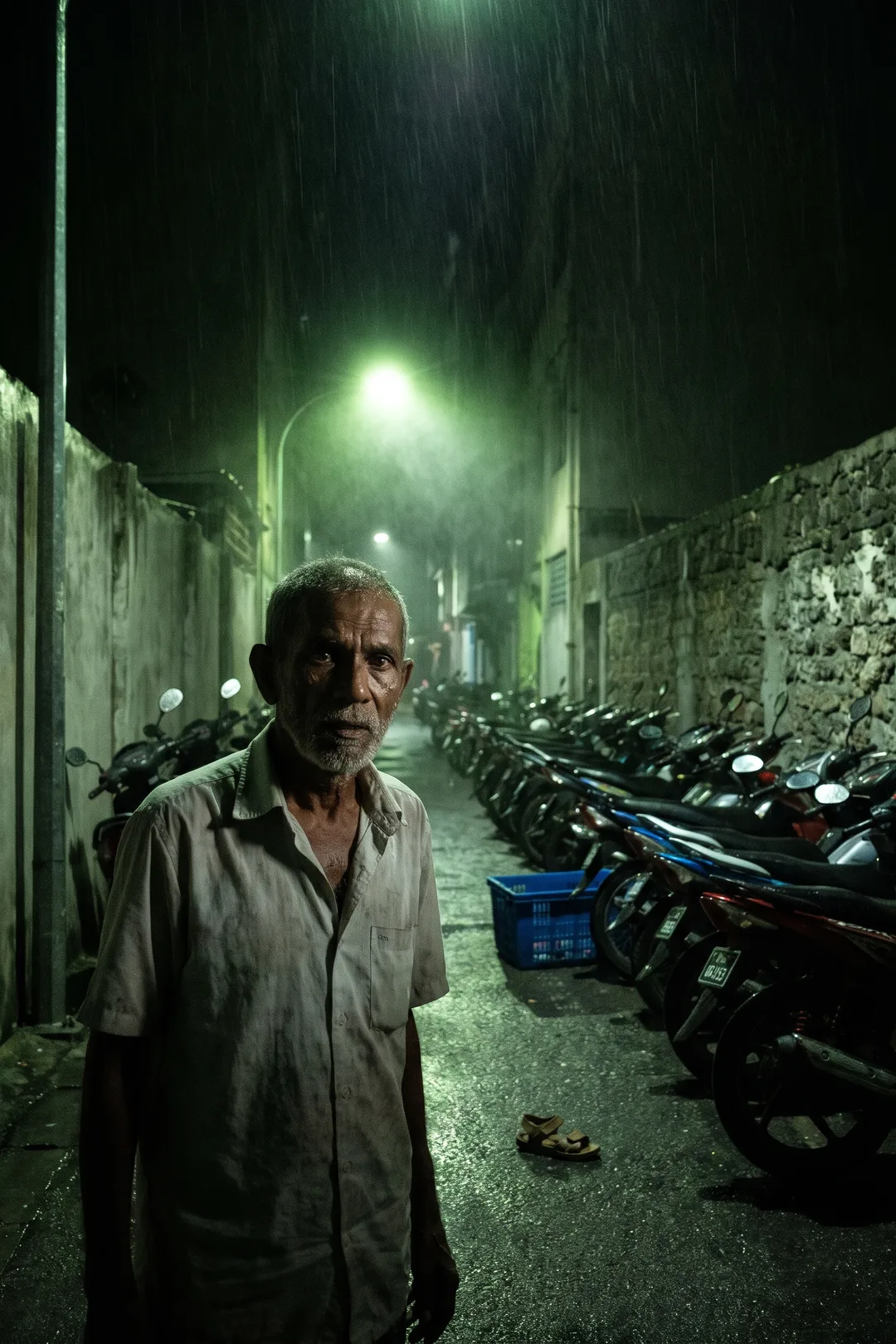
At the jeepney stop his phone buzzed with a text from Mang Dado: he had told the agency Rico was sick tonight, and Rico should rest. He meant to go home and sleep through the night shift. His feet kept turning on the pavement toward the bay, the same small turn as in the theatre, and he held the signpost until a jeepney came. On the ride he picked the fare for the trip back that night out of the coins in his palm and buttoned it into his shirt pocket before he had decided anything.
Should this become an Enigma video?
0 votes
Comments
Be kind. An editor checks every comment before it appears.
No comments yet. Be the first.