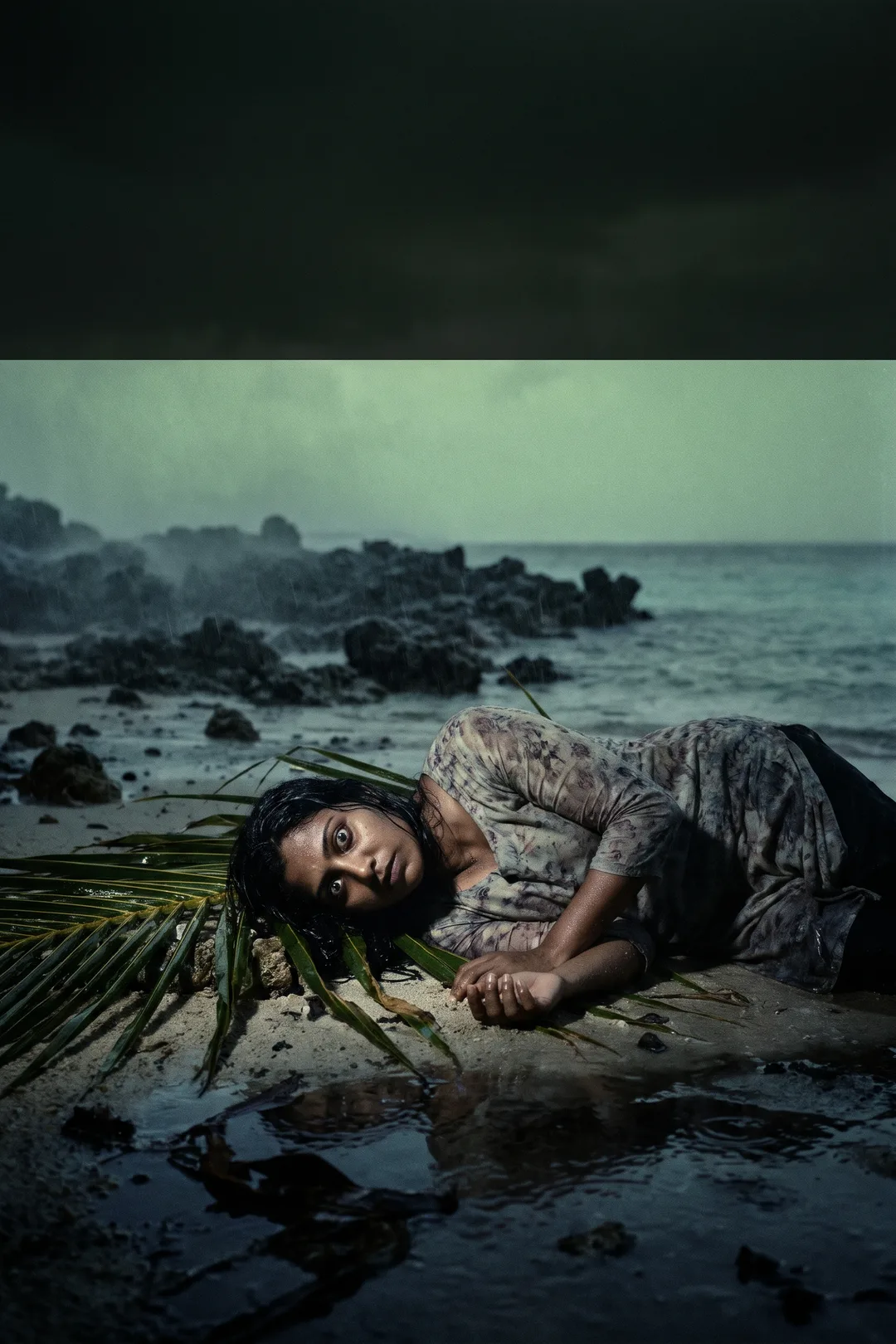
Nan Madol: Flying Stones and the Islets of the Dead
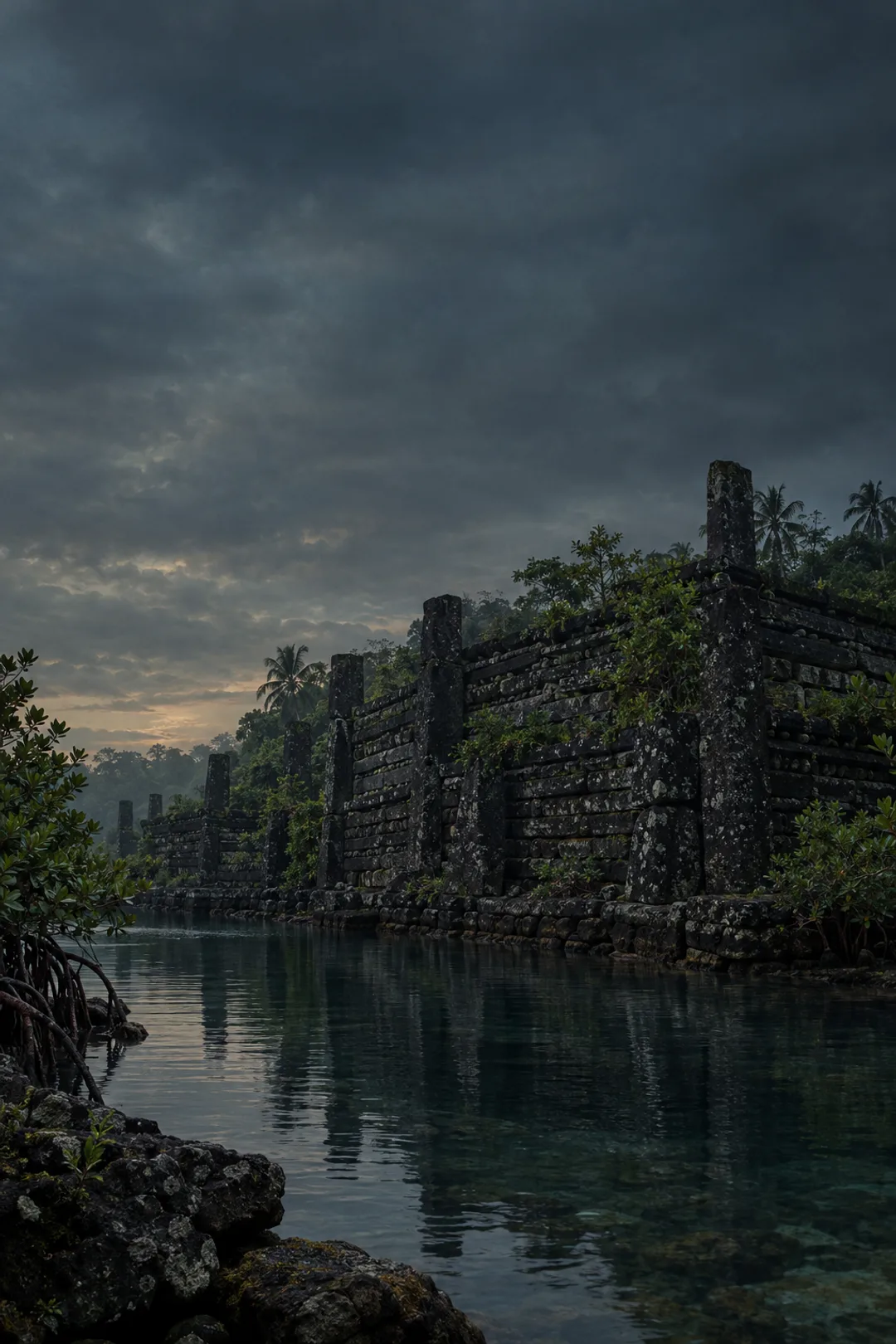
Long black stone columns stacked like logs into walls taller than a house, on a reef, with seawater for streets: that is Nan Madol, a ruined city built on artificial islets off the island of Pohnpei, in Micronesia. Pohnpeians built it under the Saudeleur dynasty, with its great walls going up from around AD 1180, and Pohnpeian legend says two sorcerers flew the stones there with the help of a dragon. Nobody has shown how the columns were really moved. Fifty-eight of its islets belong to the dead, and in 1907 a German governor who had been digging at the ruins died, a death many retellings put down to the spirits he disturbed.
What Nan Madol is
Nan Madol sits on a reef off Temwen Island, on the east side of Pohnpei, in the Federated States of Micronesia. By most counts it is close to a hundred small artificial islets, separated by tidal channels. The name is usually translated as something like "spaces between", which fits a city where the streets are water.
The walls are made of long, many-sided basalt columns laid in alternating crosswise layers, with coral rubble filling the inside. It was the ceremonial and political seat of the Saudeleur dynasty, the rulers who held Pohnpei before the island's later system of chiefs. UNESCO lists it as a World Heritage Site.
Who built it, according to Pohnpei
Pohnpeian tradition has a clear answer. Twin sorcerers named Olisihpa and Olosohpa came from Western Katau, a mythical land also called Kanamwayso. In the legend they used magic to raise the huge stones, which flew through the air to the reef with the help of a flying dragon.
The story keeps going after the building is done. Olisihpa, the elder brother, dies, and Olosohpa goes on to become the first Saudeleur. In the oral history that follows, the Saudeleur rulers become harsher over generations, demanding food and labour from the people of the island. Their rule is ended by Isohkelekel, a legendary hero who arrives from outside and defeats the last Saudeleur.
This is living tradition, told by Pohnpeians about their own ancestors, and it deserves to be read that way. It explains who built Nan Madol and why it matters, which is a different question from the one a lab report answers.
What archaeologists actually know
Radiocarbon dates show people building islets on the reef by around the 8th or 9th century AD. In 2016 a team led by archaeologist Mark McCoy dated coral used in the Nandauwas tomb and put the first megalithic walls at about AD 1180 to 1200. That rules out the popular claim that Nan Madol is the leftover of some lost ancient civilisation. The builders were the ancestors of today's Pohnpeians, working under the Saudeleur.
The basalt wasn't quarried on the reef. Geochemical studies of the stone point to more than one source elsewhere on Pohnpei, and Sokehs, on the far side of the island, is the one most often named. A typical column is often estimated at around five tonnes, and the largest stones are claimed to weigh several times that, though the figures vary and are rarely sourced.
No written record or eyewitness account of the work survives. Researchers have proposed rafts floated around the coast, levers, ramps and a great deal of organised labour. None of these needs aliens or a sunken continent, but none has been proven at Nan Madol either. Some walls now sit below the waterline, generally put down to the reef subsiding and the sea rising since they were built.
So people know who and roughly when. The open question is how.
The islets of the dead
The northeast of the city, called Madol Powe, is the mortuary sector, 58 islets set aside for the dead. At its centre is Nandauwas, the largest enclosure at Nan Madol. You reach it by boat at high tide, between mangroves, and the outer wall rises straight from the water, black columns stacked several times a person's height. Inside is a courtyard and a burial chamber roofed with more stone columns, associated with the Saudeleur rulers.
The story told most often about the graves comes from the German colonial years. In 1907 Victor Berg, the German district governor of Pohnpei, dug at the ruins, and by most retellings he opened the royal burials. The version usually repeated says he was dead within a day or so. Accounts differ on the details, and some give the cause as sunstroke. As the story is told, Pohnpeians said the spirits of the place he had disturbed killed him. His death is on record. The cause people gave it belongs to tradition.
The old telling has other things in it. On the islet of Idehd, it says, priests fed turtle innards to a sacred eel that stood for the island's deity. Guides and visitors commonly repeat that local people avoid parts of the ruins at night, the mortuary islets most of all. These accounts are widespread, but they are tradition and travel lore, not a documented record. Online lists go much further, with curses on anyone who pockets a stone and visitors who vanished. No named source supports those claims, so they don't belong in an honest telling.
What is real is that Nan Madol is still sacred. The land is traditionally held by local owners, visitors usually pay a fee and go with a guide or with permission, and some areas are closed. When UNESCO inscribed the site in 2016, it put it straight onto the List of World Heritage in Danger, because silt is clogging the channels and mangroves are pushing the walls apart. Some visitors say the unease there comes less from talk of curses than from walking into a royal graveyard uninvited, where the island's own stories say the dead are not entirely gone.
Two more places with the same question
At Baalbek in Lebanon, the Roman Temple of Jupiter stands on three foundation blocks known as the Trilithon, each commonly estimated at around 800 tonnes. Historians credit the Romans with the work. In the quarry nearby lies a block of roughly 1,000 tonnes, the Stone of the Pregnant Woman, cut and then abandoned where it lay.
Göbekli Tepe in Türkiye goes further back, to around 9500 BCE, before farming took hold in the region. Hunter-gatherers raised its stone pillars and carved them with foxes, snakes, vultures and scorpions. They left no writing, so here the builders really are anonymous, and nobody knows what they called the place.
What is still unexplained
At Nan Madol and Baalbek, the builders' names survived and the method did not. Pohnpei remembers the Saudeleur, and Baalbek has its Romans. What has been lost is the method: the songs, the ropes, the rafts, the hundreds of people pulling at once. At Göbekli Tepe even the names are gone.
At Nan Madol, the legend fills that gap with sorcerers and a dragon. The archaeology fills it with an island that organised itself to bring tonnes of basalt across the sea. Neither has yet shown, stone by stone, how walls that tall were raised on a reef. Nandauwas is still standing at the centre of the islets of the dead, the channels around it slowly filling with silt, and the people of Pohnpei still decide who walks in.

This one stays in the archive. It is not planned as a video.
Comments
Be kind. An editor checks every comment before it appears.
No comments yet. Be the first.